These notes were written by the person who submitted this item. Appraiser.AI has not verified them, and the AI's identification and estimate may rely on them.
AI Estimated Value
Not an official valuation
$25-50
AI estimate as of September 7, 2025 · verify with a professional before acting
AI-Generated · Verify before acting
Everything on this page is generated by AI for informational purposes only. AI can make mistakes — the AI may misidentify items or misattribute them (artist, maker, brand, designer, origin, era). This is not an official valuation and should not be used for insurance, sale, tax, estate, legal, or lending purposes — or any decision requiring a certified appraisal. It is not an authoritative claim about any person, brand, or rights holder — do not share or rely on it as a factual statement about a third party. Always consult qualified professionals before making financial decisions.
This analysis also relies on unverified notes provided by the user, which may be incomplete or inaccurate and could affect the result.
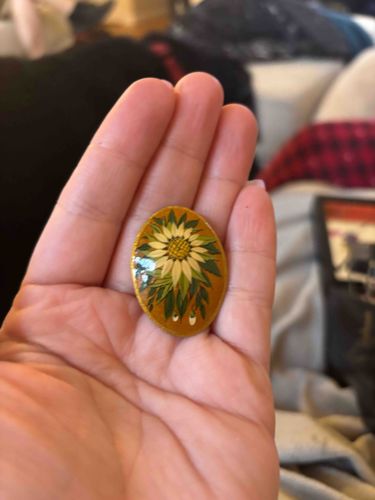
This appears to be a vintage oval-shaped brooch, likely made from wood or a similar lightweight substrate, featuring a hand-painted floral design. The primary motif is a sunflower, depicted with cream-colored or light yellow petals and a textured, golden-yellow center. Below the sunflower, there are dark green and lighter green leaves, suggesting a naturalistic arrangement. The background of the brooch is a warm, mustard yellow-gold color, which provides a rich contrast to the floral elements. The entire front surface of the brooch is coated with a clear, glossy resin or lacquer finish, giving it a smooth, protective, and somewhat reflective surface. This resin layer suggests a construction method common in mid-to-late 20th-century folk art or souvenir jewelry. The edges of the oval are visible and appear to have a slightly raised rim or be rounded. In terms of condition, there are no obvious chips, cracks, or significant abrasions visible on the resin surface beyond minor surface wear that might be expected from age and use. The colors of the painting appear vibrant and well-preserved. There are no discernible maker's marks, signatures, or manufacturing stamps visible from the provided image. The quality of the hand-painting suggests a level of individual craftsmanship rather than mass machine production. Its style is somewhat naïve but charming, consistent with vintage handmade or artisan jewelry, likely dating from the mid-20th century, perhaps 1940s-1970s. The size, as indicated by its placement in a hand, is moderate, likely between 1.5 to 2.5 inches in its longest dimension.
AI Appraisal Report
Based on my examination of the image and the provided details, this appears to be a charming vintage hand-painted sunflower brooch, likely crafted from wood or a similar lightweight substrate and encapsulated in a clear, glossy resin or lacquer. The hand-painted floral design, featuring cream/yellow petals, a golden-yellow textured center, and green leaves against a mustard yellow-gold background, exhibits a folk art or artisan style consistent with mid-to-late 20th-century handmade jewelry. The condition appears well-preserved, with vibrant colors and no obvious chips or cracks in the resin, though minor surface wear is expected for its age. This resin coating suggests durability and a common method for such pieces from the 1940s-1970s. The absence of maker's marks, while typical for this type of artisan craft, limits definitive authentication of its origin or specific artist. Authenticity, in this case, primarily refers to its vintage age and handmade nature, which I assess as highly probable based on visual cues. Market conditions for vintage artisan brooches of this style are generally stable but not indicative of high value unless associated with a known artist or significant provenance. Comparables often sell in the $20-60 range depending on design appeal and condition. Demand is moderate, appealing to collectors of vintage costume jewelry and folk art. Rarity is low, as similar handmade floral brooches were common during its likely period. Factors impacting value include its good aesthetic condition, charming design, and perceived vintage authenticity. However, the lack of a known maker, precious materials, or significant historical provenance limits its upper valuation. For full authentication, a physical examination would be necessary to confirm the substrate material, assess the actual condition of the paint beneath the resin, and inspect the pin mechanism on the reverse side. Without these, I must make assumptions about the full integrity of the piece.