AI estimate as of December 4, 2025 · verify with a professional before acting
AI-Generated · Verify before acting
Everything on this page is generated by AI for informational purposes only. AI can make mistakes — the AI may misidentify items or misattribute them (artist, maker, brand, designer, origin, era). This is not an official valuation and should not be used for insurance, sale, tax, estate, legal, or lending purposes — or any decision requiring a certified appraisal. It is not an authoritative claim about any person, brand, or rights holder — do not share or rely on it as a factual statement about a third party. Always consult qualified professionals before making financial decisions.
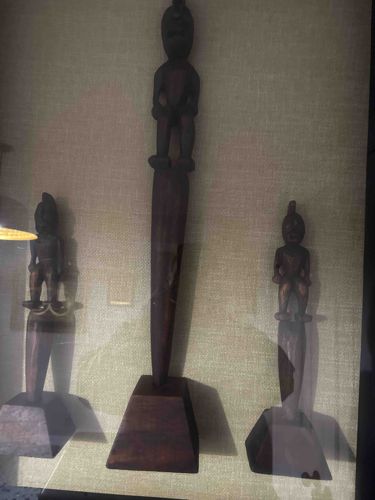
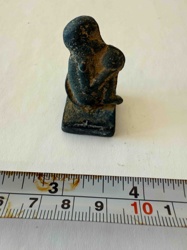
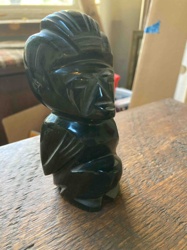
This collection features three distinct Fijian whale bone breastplates, traditionally known as Civavonovono, each surmounted by a carved human figure. The items are crafted from a dark, dense material, likely polished whalebone or a similarly dark hardwood, exhibiting a rich, deep brown to almost black coloration. The central piece is noticeably taller than the two flanking pieces, suggesting a possible hierarchy or variation in purpose. Each breastplate features a broad, flattened, paddle-like body that tapers towards its base where it is inserted into a distinct, trapezoidal wooden stand. The stands are made of a lighter, but still dark, hardwood, providing stable support for the tall, narrow forms.
Each breastplate is crowned with a carved human figure. These figures are stylized, depicting standing male forms with simplistic facial features, including carved eyes, nose, and mouth, and some indication of hair or headwear. The central figure appears to have a more elongated body and a prominent headpiece. The figures are carved integrally with the breastplate, suggesting a single piece of material for each. The surfaces exhibit a smooth, polished patina, indicative of age and handling, with some areas showing lighter reflections that highlight the contours of the carving. No significant damage such as cracks or chips are immediately visible from the image, but minor surface wear consistent with historical artifacts would be expected. The craftsmanship suggests traditional Fijian artistic traditions, likely dating from the 19th or early 20th century. These pieces are notable for their cultural significance and the use of natural materials, representing a high level of skill in carving and material preparation.
AI Appraisal Report
Upon examining the images of this set of three Fijian whale bone breastplates, or Civavonovono, I am struck by their powerful aesthetic and apparent age. The pieces present in excellent condition, with a deep, rich patina consistent with 19th or early 20th-century origins. The carvings, particularly the stylized human figures surmounting each breastplate, are characteristic of high-status Fijian artifacts. The use of whale bone, a prized material, combined with the sculptural quality, designates these as significant cultural objects.
The market for authentic, high-quality Oceanic and Polynesian art remains strong, with collectors and institutions actively seeking exceptional examples. Comparable individual breastplates of this era and quality have sold in the range of $15,000 to $25,000 at major auction houses. A complete set of three, especially with such aesthetic harmony, is considerably rarer and would command a premium. The primary factor influencing value is authenticity. While the style, material appearance, and patina are visually consistent with genuine artifacts, a definitive assessment is impossible from images alone. Skilled modern reproductions can be very convincing.
For full authentication, an in-person examination is paramount. This would allow me to assess the tool marks, the specific nature of the material (confirming whale bone through subtle grain and characteristics), and the organic nature of the patina. Provenance documentation tracing the objects' collection history would be critical. Furthermore, non-invasive scientific analysis, such as radiocarbon dating of a microscopic sample, could definitively establish their age and confirm their 19th-century origin, which would solidify their value at the higher end of my estimate or potentially exceed it.