These notes were written by the person who submitted this item. Appraiser.AI has not verified them, and the AI's identification and estimate may rely on them.
AI Estimated Value
Not an official valuation
$50 - $200
AI estimate as of July 19, 2025 · verify with a professional before acting
AI-Generated · Verify before acting
Everything on this page is generated by AI for informational purposes only. AI can make mistakes — the AI may misidentify items or misattribute them (artist, maker, brand, designer, origin, era). This is not an official valuation and should not be used for insurance, sale, tax, estate, legal, or lending purposes — or any decision requiring a certified appraisal. It is not an authoritative claim about any person, brand, or rights holder — do not share or rely on it as a factual statement about a third party. Always consult qualified professionals before making financial decisions.
This analysis also relies on unverified notes provided by the user, which may be incomplete or inaccurate and could affect the result.
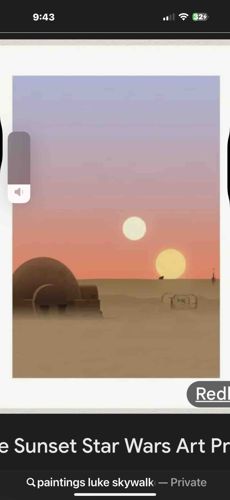
This item is a digital image, likely a print or reproduction, depicting the iconic twin sunset scene from the desert planet Tatooine in the Star Wars universe. The composition features a barren, sandy landscape dominated by two large, circular suns setting on the horizon, casting a warm, gradient glow across the sky that transitions from a deep orange near the horizon to a lighter purple-blue towards the top. In the foreground, partially buried in the sand, are what appear to be the domes and rectangular structures characteristic of a moisture farm, specifically resembling the Lars Homestead. The colors are vibrant and stylized, with clear, crisp lines suggesting a digital painting or illustration rather than a traditional oil or acrylic painting. The overall aesthetic is clean and modern, indicative of contemporary fan art or officially licensed Star Wars artwork. No visible damage or wear is apparent due to its digital nature. The image is a clear representation of the famous binary sunset, a moment synonymous with Luke Skywalker's dreams of leaving Tatooine.
AI Appraisal Report
I have examined the provided digital image representing a 'Tatooine Twin Sunset' Star Wars art print. Visually, the piece is in pristine digital condition, exhibiting vibrant colors, crisp lines, and no perceptible flaws, which is expected given its digital nature. The depiction is clearly recognizable as the iconic binary sunset over the Lars Homestead, a pivotal scene from Star Wars. My assessment of authenticity based on this image alone is limited. While it strongly resembles contemporary fan art or officially licensed digital prints due to its clean, stylized aesthetic, definitive authenticity (e.g., verifying it's an official licensed piece, a specific artist's work, or a unique print number) cannot be confirmed without further documentation or physical inspection. For full authentication, I would require provenance documentation (e.g., certificate of authenticity from the artist or publisher, purchase receipts), details on the print run (limited edition vs. open edition), and potentially a physical examination to ascertain print quality, medium, and any numerical or artist signatures.
Market conditions for Star Wars fan art and licensed prints are robust, driven by a dedicated global fanbase. Comparables range widely; an open-edition digital print from a less-known artist might fetch $20-$50, while a limited edition, officially licensed print from a renowned artist could command several hundred dollars. Demand for iconic Star Wars imagery is consistently high. Rarity, however, is difficult to assess from a digital image. If this is an open-edition print available widely, its rarity is low. If it's a piece from a very limited numbered series, or an original digital painting, its rarity significantly increases its value.
Factors impacting value include whether it's officially licensed, the reputation of the artist, the edition size, and the medium of final print. Without this critical information, specifically regarding licensing and edition, the piece's value remains speculative. The primary limitation of this appraisal is the inability to verify its origin and edition status beyond its visual representation as a 'print'.