AI estimate as of September 18, 2025 · verify with a professional before acting
AI-Generated · Verify before acting
Everything on this page is generated by AI for informational purposes only. AI can make mistakes — the AI may misidentify items or misattribute them (artist, maker, brand, designer, origin, era). This is not an official valuation and should not be used for insurance, sale, tax, estate, legal, or lending purposes — or any decision requiring a certified appraisal. It is not an authoritative claim about any person, brand, or rights holder — do not share or rely on it as a factual statement about a third party. Always consult qualified professionals before making financial decisions.
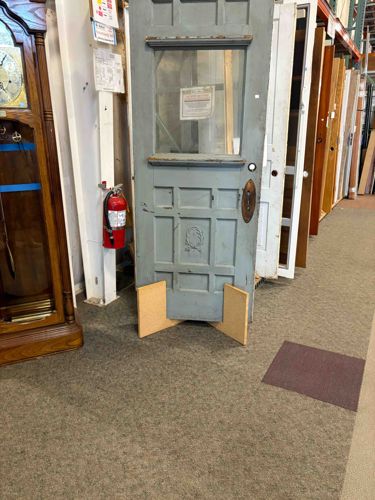
This appears to be a vintage wooden entry door, likely dating from the early to mid-20th century, given its construction and style. The door is painted a faded, light blue-gray color, showing significant distress, chipping, and wear over its entire surface, suggesting multiple layers of paint and prolonged exposure to elements. Physically, it is a solid, rectangular door primarily constructed from wood, featuring both paneled sections and a glazed (glass) top portion. The top section consists of a single large glass pane, which is obscured and appears somewhat dirty or weathered, with some possible scratches or hazing. Below the glass, there is a substantial wooden rail, and beneath that, a series of recessed panels. These panels are arranged in a classic configuration: two wider horizontal panels at the top, followed by a central square panel that appears to feature a carved or embossed decorative element, possibly a wreath or stylized botanical motif, though indistinct due to wear and paint. Below this central decorative panel are two more wider horizontal panels at the bottom. The door is fitted with antique brass or bronze hardware, specifically an oval-shaped door plate with an integrated handle, showing considerable patina and possibly some corrosion indicative of age. There is also a small, round knob or button above the main hardware, which might be part of an old lock mechanism or a doorbell. The edges of the door show scuffs and dents. No visible maker's marks or signatures are discernable from the image. The overall condition suggests it is a salvaged architectural element, possibly in need of refinishing or restoration but structurally intact.
AI Appraisal Report
Upon visual examination of this Vintage Paneled Entry Door with Glazed Top, I assess it to be an authentic architectural salvage item, likely dating from the early to mid-20th century. Its construction with recessed panels and a single-pane glazed top is consistent with this period. The heavily distressed, multi-layered light blue-gray paint, along with chips, scuffs, and dents, strongly indicates its age and prolonged exposure to elements, confirming its 'salvaged' status rather than a new reproduction. The antique brass/bronze hardware, showing significant patina and wear, further supports its vintage authenticity.
From a market perspective, salvaged doors like this have a niche demand for restoration projects, period-appropriate renovations, or as decorative architectural elements. Its condition, while authentic, would require significant labor for refinishing or restoration, including paint stripping and potential wood repair, which impacts its 'ready-to-use' value. The obscured glass pane would also likely need cleaning or replacement. The central decorative panel, while a nice feature, is indistinct due to the paint; a clearer motif would add more value.
Demand for such specific items is consistent but not typically high-volume. Rarity is moderate; while old doors are common, one with this particular panel configuration and decorative element is less so. Factors significantly impacting value are its current cosmetic state, the need for extensive restoration, and the utilitarian nature of the door itself. Were it fully restored or featuring unique, well-preserved carvings, the value would be higher.
My primary limitation in fully authenticating and valuing this item, based solely on the image, is the inability to conduct a physical inspection. Without hands-on examination, I cannot definitively assess: 1) The structural integrity of the wood (e.g., hidden rot, serious warpage, or damage that would compromise its function), 2) The exact composition and condition of the glass (e.g., leaded glass, irreparable scratches), 3) The functionality and condition of the hardware (e.g., if the lock mechanism is complete and operational), and 4) Precise wood species which could influence value. Provenance documentation, such as identifying the building it came from, would significantly enhance historical value, but is not typically available for such common salvage items.