AI estimate as of September 28, 2025 · verify with a professional before acting
AI-Generated · Verify before acting
Everything on this page is generated by AI for informational purposes only. AI can make mistakes — the AI may misidentify items or misattribute them (artist, maker, brand, designer, origin, era). This is not an official valuation and should not be used for insurance, sale, tax, estate, legal, or lending purposes — or any decision requiring a certified appraisal. It is not an authoritative claim about any person, brand, or rights holder — do not share or rely on it as a factual statement about a third party. Always consult qualified professionals before making financial decisions.
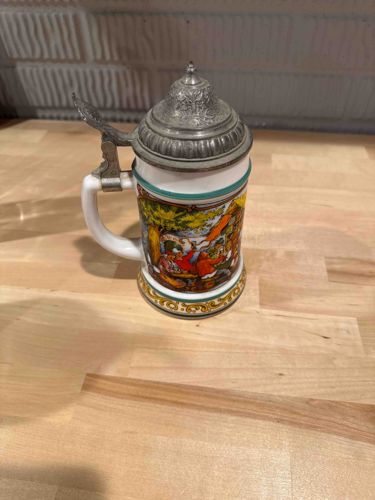
This is a miniature German-style beer stein, likely a decorative souvenir rather than a functional drinking vessel. It features a cylindrical body made of white ceramic or porcelain, with a gracefully curved handle on one side. The dominant decorative element is a colorful transfer-printed scene depicting what appears to be a festive, possibly Bavarian, gathering with several figures seated around a table amidst foliage, rendered in rich greens, reds, yellows, and browns. This main scene is bordered at the top and bottom by intricate green and gold-patterned bands, adding a touch of elegance. The stein is topped with an ornate pewter or similar base metal lid, hinged to the handle. The lid itself is domed and features embossed floral or scrollwork designs on its surface, culminating in a small finial at the apex. The metal exhibits a dull, aged patina, suggesting either lead or pewter, and shows some minor surface wear consistent with age and handling. The ceramic body appears to be in good condition with no visible cracks, chips, or significant crazing in the glaze. The overall construction points to an item made for display, with good attention to detail in the artwork and metalwork, characteristic of souvenir steins from the mid to late 20th century.
AI Appraisal Report
I have examined the provided image of this miniature German-style beer stein. Visually, the ceramic body appears to be in good condition, free from obvious cracks, chips, or significant crazing, which is a positive factor. The transfer-printed scene is colorful and well-preserved. The pewter lid shows an aged patina and minor wear consistent with its likely age and material. Authenticity as a decorative souvenir from the mid to late 20th century seems highly probable based on the construction and typical design elements of such items. The detailed artwork and metalwork indicate a well-made display piece.
Market conditions for miniature souvenir steins are generally modest. While there is a steady collector base for steins, miniature decorative versions like this do not command the same prices as larger, antique, or artist-signed functional steins. Comparables in online marketplaces and specialty auctions typically fall within a $20-$60 range for items of similar style, age, and condition. Demand is moderate, driven by niche collectors or individuals seeking decorative accents. Rarity is low, as many such souvenir steins were mass-produced.
Factors impacting value positively include its good aesthetic condition and the detailed print. Negatively, its miniature size, purely decorative function, and widespread availability limit its top-end value. Without physical examination, I cannot comment on the exact material composition of the ceramic or lid, nor can I detect hairline cracks, minor crazing, or repairs not visible in the image. Furthermore, any artist's marks, maker's marks, or production stamps on the base, which would require an in-person inspection, could influence authenticity and value. Provenance documentation could also support a higher valuation if it tied the item to a significant collection or event.