AI Appraisal Estimate

AI-generated estimates · not official valuations

From the user

What was submitted

Photo and notes provided by the user — not generated by AI

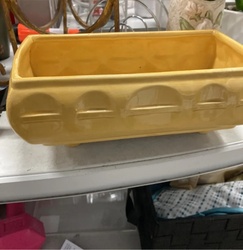
Submitted item photo
Submitted photo · June 6, 2026

User's notes

No additional notes provided.

AI analysis below

AI appraisal

AI analysis & estimate

AI-Generated · Verify before acting

Everything below is generated by AI for informational purposes only. AI can make mistakes — the AI may misidentify items or misattribute them (artist, maker, brand, designer, origin, era). This is not an official valuation and should not be used for insurance, sale, tax, estate, legal, or lending purposes — or any decision requiring a certified appraisal. It is not an authoritative claim about any person, brand, or rights holder — do not share or rely on it as a factual statement about a third party. Always consult qualified professionals before making financial decisions.

Read the full disclaimer

AI Identification

·Not independently authenticated·Verify before acting

Reticulated Ceramic Serving Dish (Underside View)

Ceramics/Pottery

AI Estimated Value

·Not an official valuation·Verify before acting

$30-50

As of June 6, 2026

AI Item Analysis

·AI can make mistakes·Verify before acting
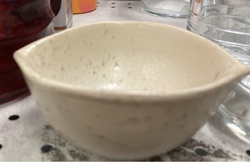
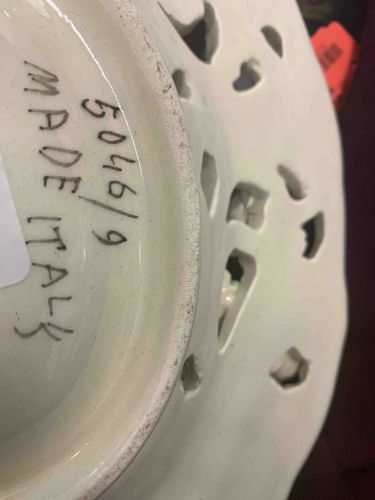
This item is a ceramic serving dish or bowl, likely part of a decorative set. The visible portion shows the underside of the piece, revealing a creamy off-white glaze with a slight sheen. The construction appears to be molded ceramic with a scalloped or undulating rim, featuring intricate reticulated (pierced or openwork) designs around the edge. These cutout patterns, comprising various geometric shapes such as ovals, diamonds, and irregular oblong holes, are consistently spaced and contribute to a delicate, lace-like appearance. The craftsmanship demonstrates attention to detail in the precise cutting and finishing of these apertures, which would have been done prior to glazing and firing. Slight variations in the shape and size of the holes suggest a degree of hand-finishing or an artisanal production method rather than purely industrial manufacturing. The underside of the rim where it meets the base shows some very minor dirt accumulation or discoloration in the grooves, indicating past use or handling. The glaze itself appears largely intact with no obvious chips or cracks visible in the photographed area. A key distinguishing mark is hand-painted in black ink on the base: '5046/9' and 'MADE ITALY'. The 'MADE ITALY' inscription indicates its country of origin, suggesting an item of Italian pottery, often associated with decorative and functional ware produced from the mid-20th century onwards. The '5046/9' likely represents a model or production number. The overall aesthetic points to a traditional or possibly vintage European style, emphasizing decorative appeal alongside functionality. The quality of the glaze application appears even, contributing to the item's polished appearance.
AI Appraisal Report

·AI can make mistakes·Verify before acting
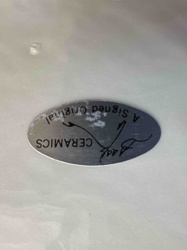
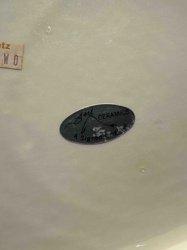
Upon examining the images of this reticulated ceramic serving dish, I can assess its key characteristics and provide an initial valuation. The piece is of Italian origin, as clearly marked 'MADE ITALY' on the underside, a common feature of mid to late 20th-century European pottery. The model number '5046/9' suggests it was part of a specific production line. The craftsmanship, particularly the openwork or 'reticulated' design, is a significant feature, lending it a delicate, decorative quality. While the piercing may have been partially machine-aided, the slight irregularities suggest some level of hand-finishing, which is common for this type of ware. The cream-colored glaze appears even and intact in the visible areas, with only minor signs of use or age-related discoloration in the crevices, placing it in very good vintage condition. The market for mid-century Italian ceramics is stable but varies greatly depending on the maker, which is not identified here. Without a manufacturer's mark (e.g., Bitossi, Capodimonte, or a specific artist), the piece is considered decorative Italian pottery. Similar unsigned or lesser-known factory-produced reticulated dishes from this era are relatively common and command modest prices. Demand is driven by decorative appeal rather than collector rarity. The primary value driver is its aesthetic quality and condition. For full authentication, an in-person examination would be necessary to check for any hidden maker's marks, hairline cracks, or repairs not visible in the photos. Verifying provenance with original receipts would also solidify its production date and history.

Get your items appraised

Instant estimates of your treasures with AI-powered appraisals

Browse More Appraisals