AI estimate as of November 19, 2025 · verify with a professional before acting
AI-Generated · Verify before acting
Everything on this page is generated by AI for informational purposes only. AI can make mistakes — the AI may misidentify items or misattribute them (artist, maker, brand, designer, origin, era). This is not an official valuation and should not be used for insurance, sale, tax, estate, legal, or lending purposes — or any decision requiring a certified appraisal. It is not an authoritative claim about any person, brand, or rights holder — do not share or rely on it as a factual statement about a third party. Always consult qualified professionals before making financial decisions.
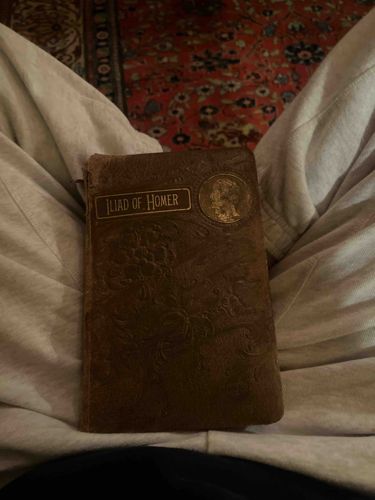
This is an antique or vintage hardbound book, titled "Iliad of Homer". The cover appears to be made of a dark brown, possibly leather or faux leather material, showing signs of age and wear. The front cover features an intricate embossed or debossed floral or scrollwork pattern that covers the majority of the surface. Prominently displayed in the upper left quadrant of the cover is a rectangular gold-colored panel with the title "ILIAD OF HOMER" in a clear, sans-serif font. To its right, there is a circular gold-colored medallion or emblem, also embossed, depicting a profile portrait believed to be Homer. The portrait is detailed, showing classical features and hair. The book exhibits visible signs of wear consistent with age, including scuffing and minor discoloration on the cover, particularly around the edges and corners, indicating it has been handled frequently. The overall construction appears solid, characteristic of older bindings designed for durability. The style of the title panel and the embossed medallion suggests a publication from the late 19th or early 20th century. The quality of the embossing on both the cover pattern and the medallion indicates a degree of craftsmanship, though the material's current condition suggests a utilitarian rather than luxury binding. No specific manufacturing marks or signatures are visible in the provided image.
AI Appraisal Report
Based on my visual examination of the provided image, this antique edition of the 'Iliad of Homer' appears to be a late 19th or early 20th-century publication. The dark brown cover, likely leather or faux leather, features a detailed embossed floral pattern and a prominent gold-colored title panel and Homeric medallion. The design is characteristic of decorative bindings from this period, often produced for general readership rather than as fine press editions.
Condition-wise, the book shows significant signs of age and handling. Scuffing, minor discoloration, and wear are evident on the cover, particularly around the edges and corners. This wear suggests a well-used but structurally sound volume, consistent with its age. Authenticity, based solely on visual inspection, points to a genuine antique book from the period described; however, I cannot verify print year, publisher, or edition without further physical inspection of the title page, copyright page, and any publisher's marks. Limitations in authenticity verification from images alone are significant.
Market conditions for such volumes are generally robust, but demand is primarily for editions with excellent condition, notable publishers, or special features. This particular volume, while appealing, falls into a broad category of decorative antique books. Comparables suggest that similar worn, non-first, or unsigned editions typically range in value. The relative commonness of 'Iliad' editions from this era limits rarity. Factors impacting value include the utilitarian nature of the binding materials (even if originally leather, its current condition reduces its luxury appeal), the lack of specified publisher or edition notoriety, and the wear. To fully authenticate and assess precise value, an in-person examination is crucial to identify publisher, year of publication, and confirm binding material, along with internal page condition. Provenance documentation would also be beneficial if available.