AI Appraisal Estimate

AI-generated estimates · not official valuations

From the user

What was submitted

Photo and notes provided by the user — not generated by AI

Submitted item photo
Submitted photo · June 9, 2026

User's notes

Fenton Carnival Glass

AI analysis below

AI appraisal

AI analysis & estimate

AI-Generated · Verify before acting

Everything below is generated by AI for informational purposes only. AI can make mistakes — the AI may misidentify items or misattribute them (artist, maker, brand, designer, origin, era). This is not an official valuation and should not be used for insurance, sale, tax, estate, legal, or lending purposes — or any decision requiring a certified appraisal. It is not an authoritative claim about any person, brand, or rights holder — do not share or rely on it as a factual statement about a third party. Always consult qualified professionals before making financial decisions.

Note

This analysis also relies on unverified notes provided by the user, which may be incomplete or inaccurate and could affect the result.

Read the full disclaimer

AI Identification

·Not independently authenticated·Verify before acting

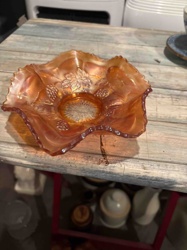
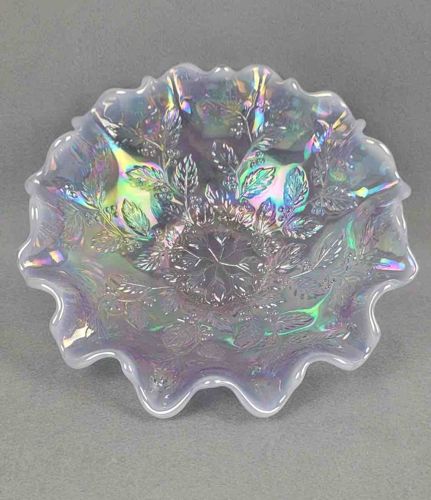
Fenton Holly Pattern Carnival Glass Bowl in White Opalescent

Antique Collectible Glassware

AI Estimated Value

·Not an official valuation·Verify before acting

$175.00 - $250.00

As of June 9, 2026

AI Item Analysis

·AI can make mistakes·Verify before acting
This is a vintage Fenton Art Glass bowl featuring the popular 'Holly' pattern, characterized by its intricate molded design of holly leaves and berries that radiate outward from a central star-like medallion. The bowl is crafted in a 'white' carnival glass treatment, which utilizes a translucent opalescent base glass topped with a signature iridescent iridized finish. This finish creates a stunning range of secondary colors, including flashes of pink, lavender, gold, and green when viewed at different angles. The bowl features a deeply ruffled or crimped edge (often referred to as a pie-crust edge), which demonstrates the hand-finished quality typical of Fenton’s production. The glass displays high quality with sharp mold details in the foliage and fruit. This specific style and pattern generally date back to the early 20th century, likely between 1910 and 1920 (the classic era of Carnival Glass), though Fenton reproduced similar pieces in later decades. The visible condition appears excellent, with no apparent chips, cracks, or significant loss to the iridescence, which can often wear thin on higher points of the molding. The opalescence is particularly strong on the ruffled rim, providing a milky contrast to the shimmering interior. Such pieces are highly collectible for their light-catching properties and the craftsmanship of the hand-crimp work.
AI Appraisal Report

·AI can make mistakes·Verify before acting
Based on my visual examination of this Fenton Holly pattern bowl, the piece exhibits the hallmark characteristics of the 'classic' carnival glass era, specifically circa 1911–1920. The white opalescent treatment is particularly desirable among collectors compared to more common marigold or amethyst hues. The iridized finish presents a superior 'pastel' luster, with the expected flashes of lavender and gold that indicate a well-preserved surface. The crimped 'pie-crust' edge is symmetrical and well-executed, suggesting high-quality control during the hand-finishing process. Market demand for Fenton Holly remains stable, though price is heavily dictated by the 'frostiness' of the white base and the intensity of the iridescence. Condition appears excellent; I observe no significant 'silvering' or loss of finish on the high-relief berries, which is where wear typically occurs first. Comparable sales for white opalescent Holly bowls in this state generally fall within the $175 to $250 range, whereas rarer colors like aqua opalescent would command significantly more. However, a definitive appraisal is limited by the digital format. In-person inspection is required to check for 'flea bites' on the base ring and internal heat cracks (annealing lines) which can be invisible in photographs. I would also need to verify the absence of the 'Fenton' script logo in the glass; its presence would indicate a 1970s reissue, which would reduce the value by approximately 60-70%. Full authentication requires tactile verification of glass weight and a blacklight test to observe the fluorescence of the base glass, ensuring it matches early 20th-century chemical compositions.

Get your items appraised

Instant estimates of your treasures with AI-powered appraisals

Browse More Appraisals