These notes were written by the person who submitted this item. Appraiser.AI has not verified them, and the AI's identification and estimate may rely on them.
AI Estimated Value
Not an official valuation
$40 - $70
AI estimate as of November 5, 2025 · verify with a professional before acting
AI-Generated · Verify before acting
Everything on this page is generated by AI for informational purposes only. AI can make mistakes — the AI may misidentify items or misattribute them (artist, maker, brand, designer, origin, era). This is not an official valuation and should not be used for insurance, sale, tax, estate, legal, or lending purposes — or any decision requiring a certified appraisal. It is not an authoritative claim about any person, brand, or rights holder — do not share or rely on it as a factual statement about a third party. Always consult qualified professionals before making financial decisions.
This analysis also relies on unverified notes provided by the user, which may be incomplete or inaccurate and could affect the result.
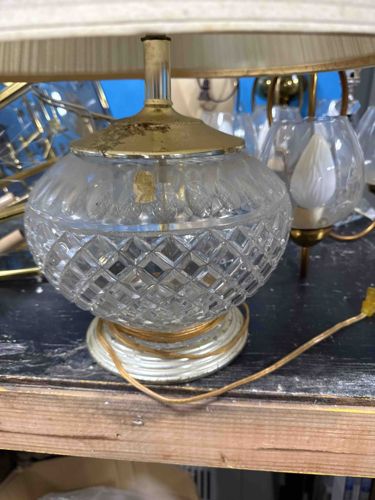
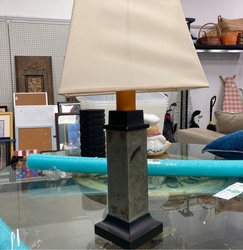
This item is a decorative table lamp featuring a clear, cut glass body with distinct diamond-cut patterns. The lamp's base is a round, somewhat flattened orb shape, crafted from clear glass that exhibits a pleasing sparkle due to the faceted design. The diamond cuts cover the majority of the glass body, providing texture and light-refracting qualities. The top portion of the lamp's body transitions into a smooth, untextured glass section before meeting a tarnished brass-tone metal cap. This metal cap, which supports the lamp's neck and shade fitter, shows significant signs of age and wear, including discoloration, pitting, and what appears to be some greenish patina, indicating oxidation. Extending from the metal cap is a clear, possibly acrylic or glass, column that acts as the neck of the lamp. A cream or off-white pleated fabric lampshade, possibly with a gold interior, is visible at the top, though only the lower edge is clearly seen. The lamp sits on a circular white base, which appears to be made of ceramic or painted wood, around which a light-colored electrical cord (possibly gold or clear plastic-coated) is wrapped. The cord extends from the rear of the lamp with a standard two-prong plug. The overall style suggests a mid-20th century to late 20th-century decorative piece, possibly aiming for a classic or traditional aesthetic. While 'Waterford' was provided as context, there are no discernible manufacturer's marks, signatures, or specific indicators of Waterford crystal on the visible surfaces of the lamp body, such as an acid-etched mark or sticker. The quality of the glass cutting appears to be factory standard, without the exceptional detail often associated with premium crystal manufacturers. Condition issues include the heavily tarnished and possibly corroded metal components, minor wear on the white base, and general dust/grime accumulation. The electrical cord also appears to be older, which could pose a safety concern.
AI Appraisal Report
I have examined the provided image of this cut glass table lamp with a fabric shade. The lamp features a clear, diamond-cut glass body, a tarnished brass-tone metal cap, a clear neck, and a pleated fabric shade. It sits on a white circular base with an older electrical cord. The overall style suggests a mid to late 20th-century decorative piece.
Regarding condition, the most significant issue is the heavily tarnished and possibly corroded metal cap, showing discoloration, pitting, and green patina. This detracts significantly from its aesthetic appeal. There is minor wear on the white base and general dust/grime. The older electrical cord also raises safety concerns and would likely require replacement.
The owner mentioned 'Waterford' as context; however, I cannot find any discernible manufacturer's marks, signatures, or specific Waterford indicators such as an acid-etched mark or sticker on the visible surfaces. The quality of the glass cutting appears to be factory standard rather than the exceptional detail often associated with premium crystal manufacturers like Waterford. Without physical inspection, a thorough examination for such marks is impossible.
In terms of market conditions, lamps of this style are quite common. While cut glass can be desirable, the lack of a known prestigious maker significantly impacts value. Comparables for unsigned, mass-produced cut glass lamps in this condition typically range from $20-$80 on secondary markets, depending on the shade's condition and the severity of metal tarnish. The heavily tarnished metal components and the generic nature of the glass design contribute to a lower market demand.
To definitively authenticate this lamp as Waterford or any other specific manufacturer, a physical examination would be crucial to search for subtle marks or features not visible in images. Provenance documentation, such as original purchase receipts or certificates, would also be invaluable. Scientific testing of the glass composition could also provide clues but is generally not cost-effective for items in this price range. Without such verification, this lamp is appraised as an unsigned, decorative cut glass lamp.