AI estimate as of October 14, 2025 · verify with a professional before acting
AI-Generated · Verify before acting
Everything on this page is generated by AI for informational purposes only. AI can make mistakes — the AI may misidentify items or misattribute them (artist, maker, brand, designer, origin, era). This is not an official valuation and should not be used for insurance, sale, tax, estate, legal, or lending purposes — or any decision requiring a certified appraisal. It is not an authoritative claim about any person, brand, or rights holder — do not share or rely on it as a factual statement about a third party. Always consult qualified professionals before making financial decisions.
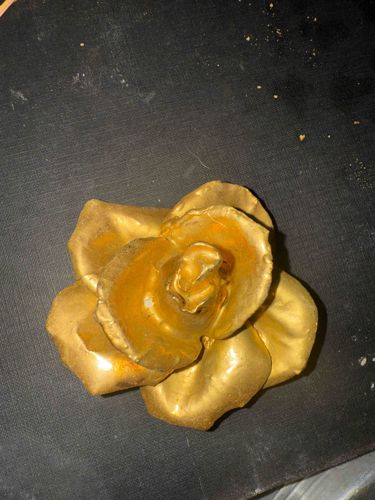
This item appears to be a three-dimensional representation of a rose, finished with a metallic gold coating. It exhibits the characteristic layers of petals, with the outer petals being larger and more distinctly formed, gradually dwindling into a tighter coil at the center, mimicking a blooming rosebud. The material underlying the gold finish is not definitively discernible from the image, but the texture suggests it could be carved wood, a resin cast, or possibly a metal that has been gilded. The overall color is a bright, somewhat reflective gold, with variations in shade and luster, potentially indicating areas of wear or differing application of the gilding. Some areas, particularly on the edges and raised surfaces of the petals, show slight discoloration or tarnishing, appearing as a more muted or even slightly brownish-orange hue, suggesting age or handling. There are no clear visible markings, such as a maker's mark or signature, from the provided image. The construction appears solid and sculptural, with the petals forming a cohesive unit. The craftsmanship, while appearing to create a realistic flower shape, has a slightly stylized or decorative quality. Given its size, which appears to be a few inches in diameter based on the context of the dark surface it rests upon, it could function as a decorative standalone object, part of a larger assemblage, or even a component of an elaborate brooch or other piece of jewelry. There are some minor specks of what appears to be dust or debris on the black background and slightly on the item itself, which are superficial and not indicative of damage to the item. The item likely dates from the mid-20th century to contemporary, depending on the manufacturing technique.
AI Appraisal Report
I have examined the provided image of what appears to be a Gilded Rose Sculpture or Brooch Element. Based on its visual characteristics, it presents as a three-dimensional representation of a rose with a metallic gold coating. The craftsmanship suggests a decorative quality, consistent with mid-20th century to contemporary decorative arts.
My assessment of its condition from the image indicates good overall preservation, with minor discoloration or tarnishing on edges and raised surfaces, consistent with age or handling. The underlying material is not definitively discernible, which is a crucial factor. It could be carved wood, resin, or gilded metal. This uncertainty limits a precise valuation without physical inspection.
Authenticity cannot be fully verified from images alone. Without a physical examination, I cannot confirm the base material, the nature of the gilding (e.g., true gold leaf vs. paint), or the presence of any hidden maker's marks or structural elements that would indicate its original purpose (e.g., a brooch pin attachment). Provenance documentation would also be invaluable, but is absent.
In terms of market conditions, similar gilded floral elements, often made from base metals, resin, or wood, are generally found in the decorative arts or costume jewelry markets. Demand for such items is moderate, driven primarily by aesthetic appeal rather than intrinsic material value or rarity, unless it's attributed to a known artisan or manufacturer. Without such an attribution or a higher quality material confirmation, it's considered a decorative piece. Comparables typically range from inexpensive decorative items to more valuable pieces if significant age, material quality, or artistic merit is confirmed.
The lack of discernible markings or provenance, combined with the difficulty in assessing the underlying material and gilding quality from an image, significantly impacts its potential value. Factors that would increase value include confirmation of substantial age (e.g., antique status), precious metal content in the gilding, a rare or high-quality base material (like fine wood carving), or attribution to a renowned maker.
For full authentication and a more precise valuation, I would recommend a physical examination to ascertain the exact materials, manufacturing technique, and to search for any concealed marks. Scientific testing, such as XRF analysis for gilding composition, would also be beneficial.