AI estimate as of July 25, 2026 · verify with a professional before acting
AI-Generated · Verify before acting
Everything on this page is generated by AI for informational purposes only. AI can make mistakes — the AI may misidentify items or misattribute them (artist, maker, brand, designer, origin, era). This is not an official valuation and should not be used for insurance, sale, tax, estate, legal, or lending purposes — or any decision requiring a certified appraisal. It is not an authoritative claim about any person, brand, or rights holder — do not share or rely on it as a factual statement about a third party. Always consult qualified professionals before making financial decisions.
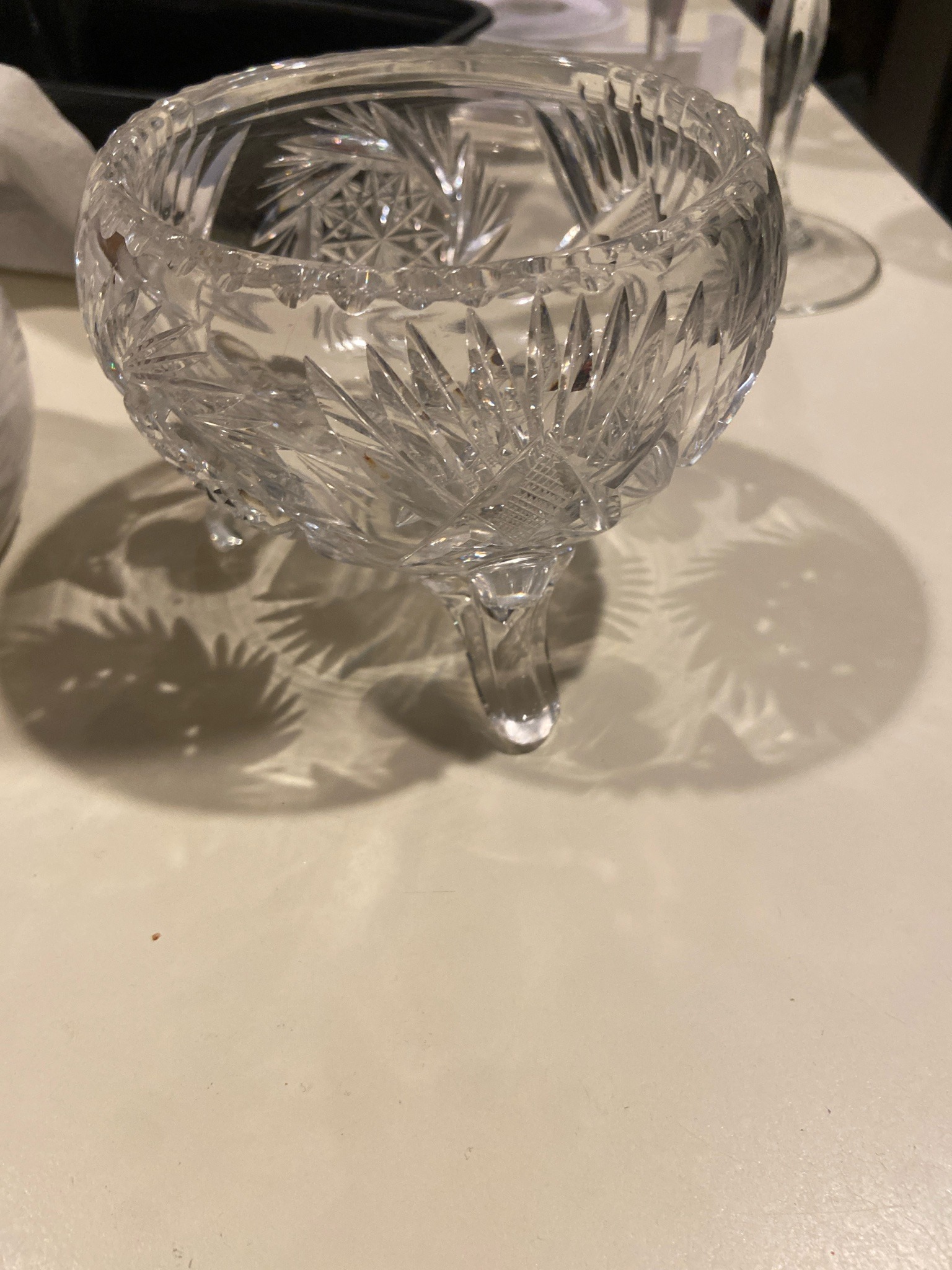
This item appears to be a clear cut crystal or heavy lead glass bowl supported by three curved, peg-style feet. The piece features intricate geometric deep-cut patterns, including multi-pointed pinwheels, fan motifs, crisscross cross-hatching, and a saw-tooth or scalloped rim. The glass exhibits high clarity and light refraction, throwing detailed shadows onto the surface below, which is typically consistent with lead crystal craftsmanship. There are no visible maker's marks, etched signatures, or manufacturer labels discernable in the photograph; thus, any specific attribution to a glassmaker such as Waterford, Brilliant Period producers, or Bohemian manufactories remains unverified and subject to in-person physical inspection. Overall, the piece appears to be in well-maintained condition, though minor surface wear or tiny flea bites along the rim edges may be present upon closer physical examination. The style is consistent with late 19th to mid-20th-century decorative glassware designs.
AI Appraisal Report
Based on what I can see in the photograph, this item appears to be a three-footed clear crystal or heavy lead glass bowl featuring deep geometric cuttings, including pinwheels, cross-hatching, and a scalloped saw-tooth rim. Based on visual characteristics, the glass exhibits good clarity and strong light refraction consistent with lead crystal. However, I cannot verify the exact lead content, age, or manufacturer from a photo alone.
Without visible signatures, acid marks, or manufacturer labels, any connection to specific makers such as American Brilliant Period producers, Bohemian workshops, or modern manufacturers like Waterford remains an unverified hypothesis. A precise attribution would require an in-person physical inspection to check for subtle acid stamps, examine the base for wear, assess the coldness and ring of the glass, and inspect for minute rim chips or flea bites.
Values for cut crystal vary significantly depending on maker attribution, age, and condition. Assuming this is a quality mid-to-late 20th-century cut lead glass piece in good condition, the fair market value typically falls in the $40 to $80 range. If an in-person examination or provenance documentation were to associate this piece with a high-end American Brilliant Period maker or prominent European manufactory, its value could increase. Conversely, if it is a mass-produced pressed-glass reproduction or modern import in the style of classic cut glass, the value would likely be lower, around $15 to $30. Secondary market demand for unattributed vintage cut crystal remains modest, as contemporary buyers generally favor marked or signed collectables.