AI estimate as of August 16, 2025 · verify with a professional before acting
AI-Generated · Verify before acting
Everything on this page is generated by AI for informational purposes only. AI can make mistakes — the AI may misidentify items or misattribute them (artist, maker, brand, designer, origin, era). This is not an official valuation and should not be used for insurance, sale, tax, estate, legal, or lending purposes — or any decision requiring a certified appraisal. It is not an authoritative claim about any person, brand, or rights holder — do not share or rely on it as a factual statement about a third party. Always consult qualified professionals before making financial decisions.
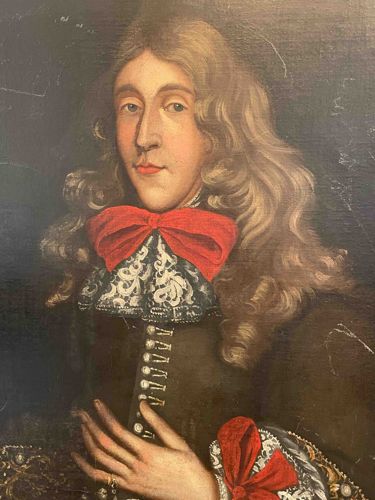
This is a full-color, waist-up portrait painting, likely executed in oil on canvas, depicting a noble or affluent male figure. The subject has fair skin, prominent cheekbones, and long, flowing light brown or blonde hair styled in typical 17th-century fashion, specifically reminiscent of the Cavalier style popular during the Stuart Restoration era. He is dressed in formal attire featuring a dark, possibly black or very dark brown, doublet with an array of decorative, possibly silver or pearl, buttons running down the front. A large, vibrant red bow is prominently tied at his neck/chest, contrasting sharply with the dark garment and the intricate black-and-white patterned lace collar peeking out from beneath. Another complementary red bow and similar lace trim are visible on the cuff of his lower left sleeve. His right hand, adorned with a ring on the pinky finger, rests gently on his chest or abdomen. The backdrop is uniformly dark, emphasizing the figure. The painting exhibits signs of age appropriate for its estimated period, including a visible craquelure pattern across the surface, indicative of drying and aging of oil paint. There are also some minor surface abrasions and dust accumulation, but no significant tears or large areas of paint loss are immediately apparent. The brushwork appears refined, especially in the rendering of the face and the delicate details of the lace and hair, suggesting a skilled artist. The overall quality and presentation point to a formal commission rather than a casual study.
AI Appraisal Report
Based on my visual examination of the provided image of the '17th Century Portrait of a Gentleman with a Red Bow,' I estimate its appraisal value. The painting's condition appears commensurate with its age; the visible craquelure is expected in a 17th-century oil on canvas. While minor abrasions and dust are present, there are no immediate signs of significant paint loss or tears, suggesting good preservation.
Authenticity, based solely on an image, is inherently limited. However, the styling, attire, and painting technique are consistent with European portraiture of the mid-to-late 17th century. The refined brushwork points to a skilled hand, likely a commissioned piece. Similar works by known, but perhaps not master, artists of the period (e.g., British, Dutch, or Flemish School) can achieve respectable values in today's market. Demand for well-preserved historical portraiture remains steady, particularly for examples with clear stylistic congruence to their period.
Factors significantly impacting value include the quality of execution, the subject's prominence (if identifiable), and the artist's identity. The striking red bow and detailed lace enhance its visual appeal. Without physical examination, I cannot confirm the paint layers, stretcher, or canvas type, which are crucial for definitive dating. For full authentication, an in-person examination is critical to assess pigment composition, verify canvas age, and inspect stretcher construction. Provenance documentation (prior ownership history) would also immensely benefit authentication and value, as would scientific analysis like IR reflectography or X-radiography to reveal underdrawings or previous alterations.