AI estimate as of August 25, 2025 · verify with a professional before acting
AI-Generated · Verify before acting
Everything on this page is generated by AI for informational purposes only. AI can make mistakes — the AI may misidentify items or misattribute them (artist, maker, brand, designer, origin, era). This is not an official valuation and should not be used for insurance, sale, tax, estate, legal, or lending purposes — or any decision requiring a certified appraisal. It is not an authoritative claim about any person, brand, or rights holder — do not share or rely on it as a factual statement about a third party. Always consult qualified professionals before making financial decisions.
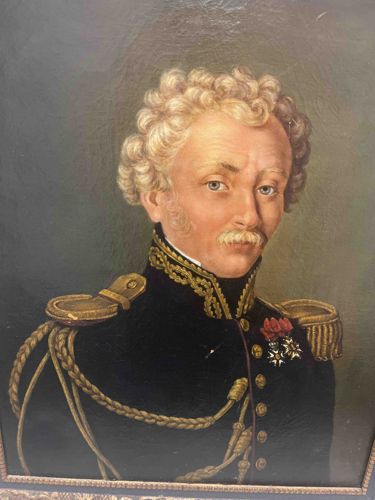
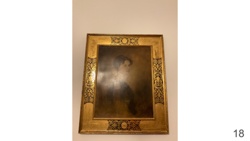
This is a captivating bust-length portrait depicting a man in what appears to be a military or naval uniform, likely from the early to mid-19th century due to the style of the uniform and hair. The physical characteristics reveal a medium-sized painting, possibly oil on canvas or panel, presented within a thin, decorative, wood frame that shows signs of age and wear. The man has light, possibly blue or grey, eyes that gaze directly out at the viewer, a light complexion, and distinctive blonde or light brown curly hair and a mustache. His uniform is dark, likely navy blue or black, adorned with elaborate gold detailing on the collar and epaulets, indicating high rank or status. Notably, on his left lapel, there are two distinct medals: a red ribbon with a circular order and a white Maltese cross-like medal with a central emblem, suggesting military honors such as the Legion of Honor. The brushwork appears refined, showcasing a skilled hand in rendering facial features and uniform details. The background is a muted, plain dark green, which allows the subject to stand out. Observable condition issues include some minor surface abrasions or dust, and potentially slight craquelure consistent with age, particularly visible on the darker uniform areas and background. No discernible artist's signature or maker's marks are visible in the provided image. The overall craftsmanship is high, suggesting a commissioned piece and a skilled artist, capturing the likeness and significant details of the sitter.
AI Appraisal Report
Based on my visual examination of the provided image, this captivating bust-length portrait appears to be an oil painting, likely on canvas or panel, dating from the early to mid-19th century. The condition appears good for its age, with minor surface abrasions, dust, and anticipated craquelure, particularly in the darker uniform and background areas. Authenticity, based solely on imagery, is limited to stylistic consistency. Without a visible signature or maker's mark, attribution is impossible. Physical examination would be crucial to confirm media, assess full condition, identify any conservation needs, and potentially uncover hidden marks. Provenance documentation tracing ownership and scientific testing (e.g., pigment analysis) would be vital for definitive authentication and artist attribution.
From a market perspective, anonymous 19th-century portraits of uniformed men, particularly those of high rank indicated by elaborate gold detailing and medals (suggesting orders like the Legion of Honor), tend to have moderate demand. While not rare in the broader art market, a well-executed portrait like this with such clear facial features and decorative elements holds appeal. The sitter's identity, if discoverable, would significantly impact value; an identified historical figure would command a premium. The current lack of attribution and provenance limits its investment potential, placing it more in the decorative arts category for collectors of historical portraiture.
Comparables for anonymous 19th-century oil portraits of this quality typically range from a few hundred to a couple of thousand dollars, depending on execution, condition, and decorative appeal. Higher-end values are reserved for works with strong artistic merit or historical significance. This piece exhibits good craftsmanship, suggesting a skilled but unknown artist.