AI estimate as of December 16, 2025 · verify with a professional before acting
AI-Generated · Verify before acting
Everything on this page is generated by AI for informational purposes only. AI can make mistakes — the AI may misidentify items or misattribute them (artist, maker, brand, designer, origin, era). This is not an official valuation and should not be used for insurance, sale, tax, estate, legal, or lending purposes — or any decision requiring a certified appraisal. It is not an authoritative claim about any person, brand, or rights holder — do not share or rely on it as a factual statement about a third party. Always consult qualified professionals before making financial decisions.
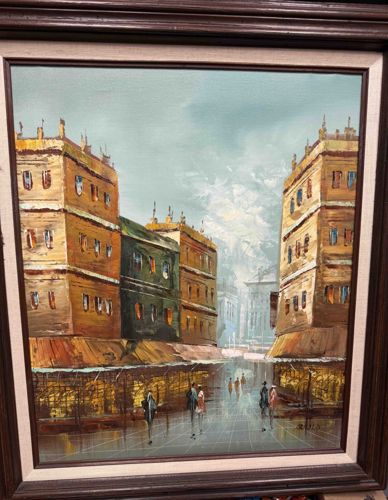
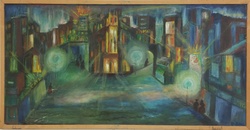
This item is an original oil painting depicting a bustling cityscape, likely Parisian, rendered with a distinctive impasto technique. The artwork is housed within a dark brown wooden frame with a subtle carved pattern, and an off-white linen or fabric liner. The painting itself showcases tall, multi-story buildings with rows of windows, predominantly in warm terracotta and amber tones, with a central building having darker green-grey hues. The perspective suggests a street or boulevard leading into the distance, with faint architectural details visible in the background under a pale, somewhat overcast sky. The foreground features several stylized figures, possibly pedestrians, rendered with minimal detail but conveying a sense of movement and urban activity. The wet-street effect, with reflections of the buildings and lights, adds depth and atmosphere. The thick application of paint (impasto) is visible throughout, especially in the building facades and the sky, creating texture and a tactile quality. The color palette primarily includes blues, greys, browns, oranges, and muted greens, with pops of white and lighter tones in the sky and reflections. A signature, possibly 'F. Nardona' or similar, appears in the lower right corner, though it is somewhat difficult to decipher from the image. The overall style is expressive and semi-abstract, characteristic of mid-20th century to contemporary street scene paintings. The frame appears to be in good condition, and the painting itself shows no immediately visible signs of damage, such as cracks, chips, or significant discoloration, maintaining its original vibrancy and texture. The craftsmanship indicates a commercial art piece, offering decorative appeal.
AI Appraisal Report
I have thoroughly examined the provided image of this Framed Parisian Cityscape Oil Painting. Based on this visual inspection, the painting appears to be in very good condition; I discern no immediate signs of cracks, chips, or significant discoloration that would detract from its aesthetic appeal. The dark brown wooden frame with its subtle carving and off-white liner also appears well-maintained, complementing the artwork effectively. The impasto technique, a defining characteristic of this piece, is evident and contributes significantly to its textural quality and expressive style. The likely signature 'F. Nardona' suggests an artist, though without further research or authentication, this name's market recognition and impact on value are unknown.
Market conditions for commercial, decorative oil paintings of cityscapes, particularly those with a semi-abstract, impasto style popular from the mid-20th century onwards, are generally stable but not exceptional. Demand exists for aesthetically pleasing wall decor, but true rarity is usually tied to established artists or unique historical significance not apparent here. Comparable sales of similar decorative street scenes by unlisted or lesser-known artists typically fall within the low to mid-hundreds.
The primary factor impacting value is the lack of a prominent artist. While the work is accomplished and visually appealing, without a known provenance or an artist with an established market, its value remains decorative rather than investment-grade. Authenticity, specifically attribution to 'F. Nardona' and confirming it as an original oil, cannot be definitively ascertained from images alone. A physical examination would allow me to confirm the medium, inspect for overpainting or repairs, and verify the signature's authenticity. In-person inspection would also reveal the precise texture, brushwork details, and true color fidelity. Thorough provenance documentation tracing ownership history would further bolster its value, especially if it linked to direct acquisition from the artist or a reputable gallery. Scientific testing, such as pigment analysis, could confirm the age and medium if questions arose during physical inspection. As a decorative piece, the estimated value reflects its aesthetic quality and condition, assuming it is indeed an original oil painting.