These notes were written by the person who submitted this item. Appraiser.AI has not verified them, and the AI's identification and estimate may rely on them.
AI Estimated Value
Not an official valuation
$1,800 - $2,500
AI estimate as of July 8, 2025 · verify with a professional before acting
AI-Generated · Verify before acting
Everything on this page is generated by AI for informational purposes only. AI can make mistakes — the AI may misidentify items or misattribute them (artist, maker, brand, designer, origin, era). This is not an official valuation and should not be used for insurance, sale, tax, estate, legal, or lending purposes — or any decision requiring a certified appraisal. It is not an authoritative claim about any person, brand, or rights holder — do not share or rely on it as a factual statement about a third party. Always consult qualified professionals before making financial decisions.
This analysis also relies on unverified notes provided by the user, which may be incomplete or inaccurate and could affect the result.
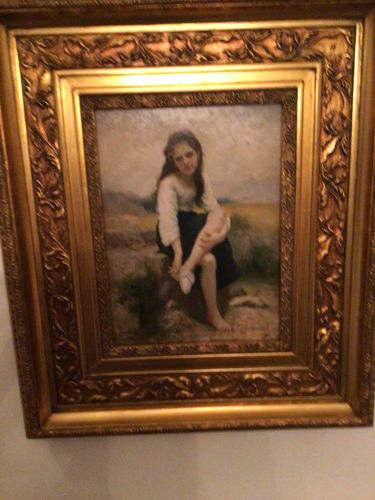
The item is an oil painting depicting a young girl, possibly a portrait or genre scene titled 'The Barefoot Girl' or similar. The girl is seated in what appears to be an outdoor setting, potentially a rural landscape with a dirt path or rocky outcrop. She wears a simple white or cream-colored blouse with long sleeves and a dark skirt. Her attention is focused on her left foot, which she holds with both hands, suggesting she might be adjusting or removing a shoe, or perhaps inspecting her foot. One shoe, either removed or being put on, is visible near her left foot. Her bare right foot is also visible. The background features muted, earthy tones, with visible brushstrokes indicating a painterly style rather than high realism, though the figure itself shows more defined detail. The overall color palette is warm, with ochre, sienna, and olive green tones dominating. The painting is housed within a substantial, ornate gilded frame. The frame features deeply carved or molded floral and foliate motifs, particularly prominent along its inner and outer edges, with a flatter, polished golden section in between. The gold leaf or finish on the frame exhibits some patina and minor signs of wear consistent with age, but no significant damage is immediately apparent. The craftsmanship of the frame appears to be of good quality, enhancing the presentation of the artwork. The style suggests a late 19th to early 20th-century European academic or genre painting, possibly influenced by artists like N. Henry Bingham as suggested, though a definitive signature or maker's mark on the canvas itself is not discernible from the image. The condition of the painting appears stable, with no obvious cracks, flaking, or major discoloration, although a comprehensive assessment would require in-person examination.
AI Appraisal Report
Based on my visual examination of the provided image, this oil painting, 'The Barefoot Girl,' presents as a charming late 19th to early 20th-century European genre scene. The condition of the painting itself appears stable, with no immediate signs of cracks, flaking, or significant discoloration visible. The muted, earthy palette and visible brushstrokes contribute to its artistic appeal. The ornate gilded frame is of substantial quality and also appears to be in good condition, showing only minor age-consistent wear, which enhances the overall presentation and value of the piece.
Regarding authenticity, the owner's suggestion of N. Henry Bingham is noted. However, without a discernible signature or maker's mark on the canvas itself, and given the limitations of image-based assessment, I cannot definitively confirm attribution to Bingham or any specific artist. While the style is consistent with academic or genre painting of the period, many artists worked in similar manners.
Market conditions for well-executed genre scenes from this period are generally steady, particularly for visually appealing pieces with good presentation. Comparable works by lesser-known but skilled artists in good condition, especially when elegantly framed, typically find a responsive market. Demand is driven by aesthetic appeal and decorative versatility. Rarity is difficult to assess without confirmed attribution, but pieces of this genre are not exceedingly rare.
Major factors impacting value include the positive condition, attractive subject matter, and the high-quality frame. However, the primary limiting factor in establishing a higher value is the unconfirmed artist attribution.
For a full authentication and more precise valuation, an in-person examination is crucial to inspect the paint surface directly, look for hidden signatures, and assess varnish condition. Provenance documentation (prior ownership history) would be invaluable, and scientific testing (e.g., pigment analysis) could further aid in dating and attribution.