AI estimate as of October 27, 2025 · verify with a professional before acting
AI-Generated · Verify before acting
Everything on this page is generated by AI for informational purposes only. AI can make mistakes — the AI may misidentify items or misattribute them (artist, maker, brand, designer, origin, era). This is not an official valuation and should not be used for insurance, sale, tax, estate, legal, or lending purposes — or any decision requiring a certified appraisal. It is not an authoritative claim about any person, brand, or rights holder — do not share or rely on it as a factual statement about a third party. Always consult qualified professionals before making financial decisions.
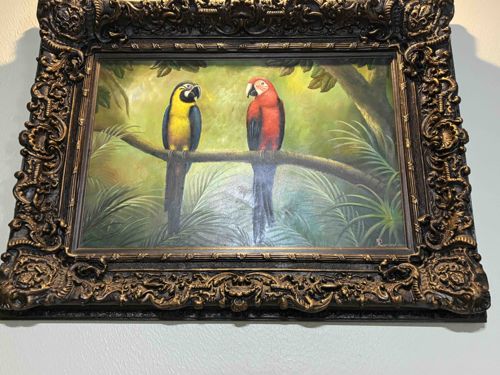
This item is an oil painting depicting two macaws perched on a tree branch amidst lush green foliage. The macaw on the left features a vibrant yellow body with blue-black wings and head, while the macaw on the right is predominantly red with some blue-black on its wings and tail. The background illustrates a vibrant tropical jungle with varying shades of green, suggestive of light filtering through the canopy. The brushwork appears to be detailed, bringing out the texture of the birds' feathers and the natural elements. The painting is housed within a highly ornate, darkly finished frame, possibly made of carved wood or a composite material with a metallic gold or bronze finish highlight. The frame features intricate floral and foliate scrollwork, particularly pronounced at the corners and along the edges, contributing to a classical or Baroque aesthetic. There is a visible artist's signature or inscription in the bottom right corner of the painting, though it is not clearly legible from the image. The overall condition of the painting appears good, with no immediately obvious major damage or repairs visible. The frame shows some signs of use consistent with its age, possibly minor chipping or wear on the raised decorative elements, and a visible patina that enhances its antique appearance. The style suggests a mid-20th century to contemporary period, embracing a realistic yet decorative approach to wildlife art. The quality of both the painting and its frame indicates a piece intended for display as a decorative art object.
AI Appraisal Report
I have examined the image of this oil painting depicting two macaws. The painting itself appears to be in good condition, showing detailed brushwork that capably renders the birds' feathers and the tropical foliage. No major damage or repairs are immediately evident. The ornate frame, likely carved wood or composite, complements the artwork well. While it exhibits some expected wear and patina, enhancing its antique aesthetic, it remains a significant decorative element. The style suggests a mid-20th century to contemporary origin, falling into a category of decorative wildlife art.
Authenticity, as always with image-based appraisals, has limitations. The visible signature in the bottom right corner is illegible from the image. To fully authenticate the artist, an in-person examination of the signature for proper hand, style, and medium consistency, alongside research into the artist's oeuvre, would be essential. Provenance documentation like receipts or exhibition history would also be crucial.
The market for decorative wildlife art, especially pieces with a strong visual appeal and an ornate frame, is stable. Comparable works by lesser-known artists in this style typically command prices in the mid-to-high hundreds to low thousands, depending on size, quality, and condition. The ornate frame significantly enhances the perceived value and decorative appeal, increasing demand compared to an unframed or simply framed piece. Rarity is not a major factor here, as many such decorative artworks exist.
Factors impacting value include the quality of execution, the aesthetic appeal of the subject matter, and the presentation in its ornate frame. While the painting quality is good, it doesn't immediately suggest a master artist’s hand without further information. Therefore, its primary value is as a highly decorative art object.
For full authentication of the artist and a more precise valuation, a physical inspection to examine paint quality, age, and the signature, combined with art historical research, would be necessary.