These notes were written by the person who submitted this item. Appraiser.AI has not verified them, and the AI's identification and estimate may rely on them.
AI Estimated Value
Not an official valuation
$200-400
AI estimate as of June 28, 2025 · verify with a professional before acting
AI-Generated · Verify before acting
Everything on this page is generated by AI for informational purposes only. AI can make mistakes — the AI may misidentify items or misattribute them (artist, maker, brand, designer, origin, era). This is not an official valuation and should not be used for insurance, sale, tax, estate, legal, or lending purposes — or any decision requiring a certified appraisal. It is not an authoritative claim about any person, brand, or rights holder — do not share or rely on it as a factual statement about a third party. Always consult qualified professionals before making financial decisions.
This analysis also relies on unverified notes provided by the user, which may be incomplete or inaccurate and could affect the result.
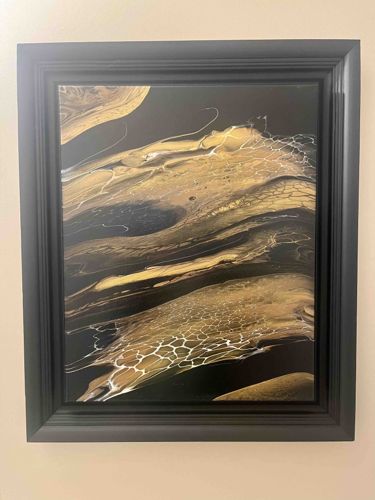
This artwork is an abstract acrylic pour painting on canvas, measuring 16x20 inches, and is presented in a portrait orientation within a simple black frame. The composition is dominated by deep black, rich gold, and bronze tones, accented with delicate veins and patches of white. The fluid art technique employed creates dynamic, sweeping forms and organic patterns that evoke images of swirling liquids, geological strata, or cosmic nebulae. A notable feature is the presence of distinctive 'cells' and lacing effects, particularly evident in the upper left and lower central areas, where the white pigment has reacted to create intricate, web-like patterns against the darker and metallic elements. The interplay of the lustrous gold and bronze hues against the matte black background provides a striking visual contrast and depth. The painting appears to be in excellent condition, with no visible signs of damage such as tears, creases, or paint loss. The surface exhibits a consistent, potentially semi-gloss, finish typical of acrylic mediums. The black frame, likely wood or a composite, features a clean, stepped profile and effectively complements the dark tones of the artwork, enhancing its contemporary aesthetic. No artist's signature or manufacturing marks are discernible from the visible surfaces. Given the technique, the piece is contemporary, likely produced in the 21st century. The execution of the pour and the successful formation of cells suggest a controlled and skilled application of the medium, indicating quality craftsmanship. The unique flow and interaction of colors make it a visually engaging piece of modern abstract art.
AI Appraisal Report
Based on my visual examination of the provided images, this Abstract Gold and Black Acrylic Pour Painting, measuring 16x20 inches, appears to be in excellent condition. No tears, creases, or paint loss are discernible, and the frame complements the artwork well. Authenticity, in terms of artist attribution, cannot be confirmed without a discernible signature or provenance; however, the artwork appears genuine to its description as a contemporary acrylic pour.
The market for contemporary decorative abstract art, particularly fluid art, is active. While there's a broad range of quality, pieces like this with well-executed 'cells' and lacing effects are sought after in the home decor market. Comparables include similar-sized, unsigned abstract works found in online marketplaces, local art galleries, and craft shows, typically by emerging or unestablished artists.
Demand for aesthetically pleasing decorative abstracts is consistent. Rarity, in terms of the specific composition, is inherent to the pour technique, making each piece unique. However, without an identified artist or significant exhibition history, it is not rare in a market-significant sense. Key factors influencing value positively include the excellent condition, appealing color combination, and clear signs of skilled technique. Conversely, the absence of an artist's signature and verifiable provenance significantly limits its market value beyond its decorative appeal.
Limitations in authenticating an artist and full provenance are substantial from images alone. A physical examination would allow me to inspect the reverse for hidden labels, assess paint thickness, and confirm materials. Crucially, provenance documentation—such as artist records, purchase receipts, or exhibition histories—is essential to establish authorship and enhance market value. Scientific analysis, while possible, is generally not warranted for contemporary decorative abstracts.