These notes were written by the person who submitted this item. Appraiser.AI has not verified them, and the AI's identification and estimate may rely on them.
AI Estimated Value
Not an official valuation
$350-550
AI estimate as of August 3, 2025 · verify with a professional before acting
AI-Generated · Verify before acting
Everything on this page is generated by AI for informational purposes only. AI can make mistakes — the AI may misidentify items or misattribute them (artist, maker, brand, designer, origin, era). This is not an official valuation and should not be used for insurance, sale, tax, estate, legal, or lending purposes — or any decision requiring a certified appraisal. It is not an authoritative claim about any person, brand, or rights holder — do not share or rely on it as a factual statement about a third party. Always consult qualified professionals before making financial decisions.
This analysis also relies on unverified notes provided by the user, which may be incomplete or inaccurate and could affect the result.
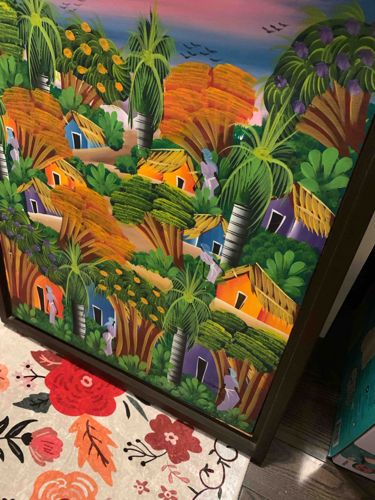
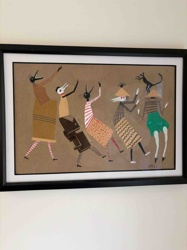
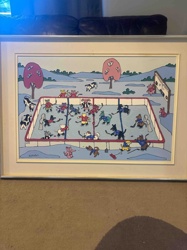
This is a vibrantly colored folk art painting, likely executed in acrylics or oils on canvas, depicting a lively village or hillside community. The composition is dense with stylized natural elements and simple architectural forms. Key physical characteristics include numerous green palm trees and other verdant foliage, suggesting a tropical or subtropical setting. The trees feature distinct, often layered, green canopy structures and light-colored, sectioned trunks. Scattered throughout the landscape are multiple small houses or huts, predominantly featuring bright orange or yellow thatched roofs and walls painted in various solid colors such as blue, purple, and orange. The overall color palette is very saturated and strong, with a notable gradient sky transitioning from pinkish-orange at the horizon to a deeper blue at the top. The brushstrokes appear bold and somewhat flat, characteristic of many folk art styles, with minimal blending, emphasizing form and color over realistic rendering. Small, dark bird silhouettes are visible in the upper sky, adding a subtle detail. While no explicit size is discernible, the painting appears substantial enough to command visual attention. The painting is housed within a dark, possibly wooden, frame that has a simple, clean profile. No visible artist's signature, marks, or stamps can be identified from the provided image. The condition appears good, with no obvious signs of significant damage like tears, chips, or major paint loss, although a closer inspection would be required to confirm this. The colors remain quite bright and appear unfaded. This type of artwork, often celebrating community life and natural beauty, suggests an origin in areas known for their vibrant folk art traditions. The specific style, with its simplified forms and bold colors, points towards a 20th-century folk art aesthetic, possibly from a Caribbean or Latin American region. The craftsmanship reflects a naive or untrained artistic approach, which is a hallmark of authentic folk art, prioritizing narrative and emotional expression over academic technique.
AI Appraisal Report
Upon examining the images of this vibrant folk art landscape painting, I am struck by its naive charm and expressive use of color. The piece depicts a lively hillside community, likely in a tropical region such as the Caribbean or Latin America, rendered in a style characteristic of 20th-century self-taught artists. The composition is dynamic, featuring stylized palm trees and brightly colored homes under a warm gradient sky. The paint application appears confident and flat, prioritizing emotional impact over academic realism, which is the hallmark of authentic folk art. Based on the photograph, the painting appears to be in good condition, with no visible tears or significant paint loss, and the colors remain strong and unfaded.
The market for anonymous folk art is broad. While signed works by recognized artists command high prices, unsigned pieces like this are valued for their decorative and aesthetic appeal. Similar unsigned, high-quality folk art landscapes from the 20th century typically sell in the low to mid-hundreds at galleries and auctions. The owner's note 'Canvas luis2000' might suggest a signature or a title, possibly 'Luís' and the year '2000', but this is not discernible from the image and requires verification. If 'Luís' could be identified as a listed artist, the value could increase substantially. However, as an anonymous work, its value is primarily decorative.
My valuation is limited by the inability to perform a physical inspection. For full authentication, I would need to examine the canvas, stretcher, and paint surface firsthand to assess age and condition more accurately. Verifying the potential signature or inscription 'luis2000' is crucial and would involve researching artist databases. Without provenance or a confirmed artist attribution, this piece is appraised based on its strong decorative qualities as an attractive example of anonymous folk art.