AI estimate as of October 13, 2025 · verify with a professional before acting
AI-Generated · Verify before acting
Everything on this page is generated by AI for informational purposes only. AI can make mistakes — the AI may misidentify items or misattribute them (artist, maker, brand, designer, origin, era). This is not an official valuation and should not be used for insurance, sale, tax, estate, legal, or lending purposes — or any decision requiring a certified appraisal. It is not an authoritative claim about any person, brand, or rights holder — do not share or rely on it as a factual statement about a third party. Always consult qualified professionals before making financial decisions.
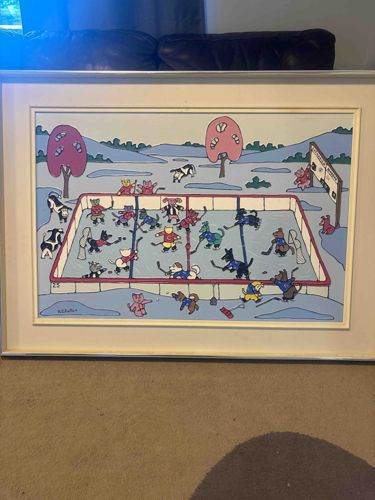
This is a framed folk art painting depicting a whimsical scene of various animals playing ice hockey. The artwork is characterized by its naive style, vibrant colors, and simplified forms. The central focus is an ice rink with red boards, where numerous anthropomorphic animals, including what appear to be dogs, cats, cows, pigs, and other creatures, are engaged in a hockey game. Each animal is rendered with distinct colors and patterns, some wearing sweaters, and all holding hockey sticks. The background features a snowy landscape with blue sky, rolling hills, and stylized pink trees with visible leaf-like shapes. One of the trees on the left is adorned with pink leaves, while another on the right has similar pink elements. In the upper right corner, there is a scoreboard with illegible text. Numerous animals are also scattered around the perimeter of the rink, some skating and others observing. The painting exhibits a flat, two-dimensional quality, typical of folk art. It is housed in a simple, off-white frame, which appears to be wooden. A signature, 'R. Schuyler', is visible in the lower left corner of the painting, along with what might be an edition number '85' or 'S5', though it is difficult to discern clearly. The overall condition appears good, with no obvious signs of major damage, repairs, or significant wear visible from the provided image. The painting's cheerful subject matter and distinct style suggest it could be a charming decorative piece, likely dating from the late 20th to early 21st century, given its contemporary folk art aesthetic.
AI Appraisal Report
I have examined the image of this framed folk art painting, 'Critter Hockey.' The condition appears good, with no overt signs of damage, repairs, or significant wear visible from the provided image. The colors are vibrant, and the simple off-white wooden frame seems appropriate for the style. The signature 'R. Schuyler' is clear, though the adjacent '85' or 'S5' is illegible, potentially an edition number or date. Authenticity, based solely on visual examination of a signature, limits definitive verification; a physical inspection for paint quality, surface texture, and closer examination of the signature and any possible edition mark would be crucial. Provenance documentation, such as purchase receipts or exhibition history, would further solidify authenticity.
In terms of market conditions, folk art, particularly whimsical animal scenes, generally enjoys a consistent but not exceptionally high demand. Comparables for signed folk art paintings of this scale and subject matter often fall within a few hundred to a thousand dollars, depending heavily on the artist's recognition and the complexity/size of the piece. The naive style and cheerful subject suggest a decorative appeal, and its 'Critter Hockey' theme is engaging. While not unique, this specific whimsical quality maintains a steady buyer interest. The artist 'R. Schuyler' does not immediately present as a widely recognized or highly collected folk artist based on my initial assessment; however, further research into the artist's body of work and exhibition history would be beneficial.
Factors impacting value include the charming subject matter and good apparent condition. Limitations in a remote appraisal include inability to verify artist's intent, the medium's specific properties, or any hidden damage. A physical inspection would allow me to confirm the medium, assess the frame's quality, locate any other identifying marks, and verify the true condition which can significantly influence the final valuation.