AI estimate as of November 1, 2025 · verify with a professional before acting
AI-Generated · Verify before acting
Everything on this page is generated by AI for informational purposes only. AI can make mistakes — the AI may misidentify items or misattribute them (artist, maker, brand, designer, origin, era). This is not an official valuation and should not be used for insurance, sale, tax, estate, legal, or lending purposes — or any decision requiring a certified appraisal. It is not an authoritative claim about any person, brand, or rights holder — do not share or rely on it as a factual statement about a third party. Always consult qualified professionals before making financial decisions.
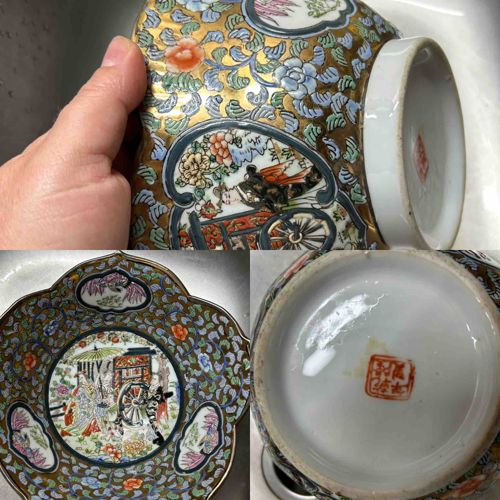
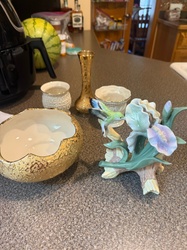
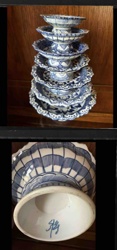
This exquisite bowl, reminiscent of Satsuma ware, is crafted from fine porcelain and features a rich, multi-colored enamel decoration with extensive gilding. The bowl has a multi-lobed or scalloped rim, a characteristic shape often found in traditional Asian ceramics. The primary decoration on the exterior consists of a dense, intricate pattern of gilt foliage and floral motifs set against a dark, possibly metallic, ground. Interspersed within this gilded background are cartouches containing detailed scenes. One clearly visible scene depicts an individual, possibly a distinguished figure or deity, riding in an ornate, wheeled carriage or palanquin, attended by another figure. This scene is rendered with fine brushwork in various enamels including blues, greens, reds, and yellows. Smaller reserves or cartouches also contain delicate floral or avian designs. The interior of the bowl's base features a central medallion with a similar elaborate scene, likely depicting additional figures or narratives, framed by the same dense gilt and enamel floral patterns that adorn the exterior. The craftsmanship appears to be of high quality, with meticulous attention to detail in the painting and gilding. The base of the bowl shows an unglazed foot rim and a white glazed interior with a red, square-shaped maker's mark or seal, indicative of its origin, likely Japanese or Chinese, and potentially dating to the late 19th or early 20th century. There are no obvious signs of significant damage or repairs, though some wear to the gilding might be present given its age. The condition appears commensurate with age and handling. This piece exhibits strong aesthetic appeal due to its vibrant colors, intricate design, and luxurious gilding, making it a decorative and collectible item.
AI Appraisal Report
Based on my visual examination of the provided image, this Antiqued Satsuma-style Gilt Floral and Cart Scene Porcelain Bowl presents as a well-preserved decorative ceramic piece. The multi-lobed form, rich multi-colored enamel decoration, and extensive gilding are characteristic of Satsuma-style wares, popular in the late 19th and early 20th centuries. The intricate brushwork in the cartouche scenes, particularly the cart and figure, and the dense gilt foliage speak to a good level of craftsmanship. The visible red square maker's mark on the unglazed foot rim is a positive indicator of original manufacture. Condition appears commensurate with age, with no immediate signs of significant damage or repairs, although some minimal wear to the gilding is expected over time and cannot be fully assessed without in-hand inspection.
Market conditions for Satsuma-style porcelain remain steady, with higher demand for pieces exhibiting exceptional detail, vibrant enamels, and specific artist signatures. While this piece is attractive, the 'antiqued' style suggests it might be a later interpretation rather than a true antique Satsuma piece from the Meiji period, which would command higher prices. The depiction of figures in a cart is a common but appealing motif. Its rarity is moderate, as many similar decorative pieces were produced during the period.
Factors impacting value include its decorative appeal, lack of apparent damage, and the intricate design. However, the exact age and origin (Japanese or Chinese, and the specific workshop) cannot be definitively confirmed from images alone. For full authentication and to precisely date the piece, an in-person examination is crucial to assess the quality of the ceramic body, the exact nature of the enamels and gilding, and to interpret the maker’s mark fully. Provenance documentation would also be invaluable. Without these, the 'Satsuma-style' designation is appropriate, suggesting influence rather than definitive origin.