AI Appraisal Estimate

AI-generated estimates · not official valuations

From the user

What was submitted

Photo and notes provided by the user — not generated by AI

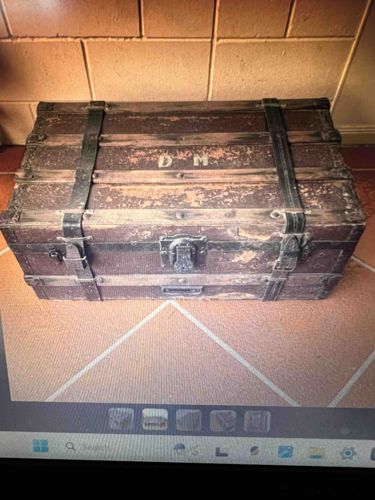
Submitted item photo
Submitted photo · June 10, 2026

User's notes

No additional notes provided.

AI analysis below

AI appraisal

AI analysis & estimate

AI-Generated · Verify before acting

Everything below is generated by AI for informational purposes only. AI can make mistakes — the AI may misidentify items or misattribute them (artist, maker, brand, designer, origin, era). This is not an official valuation and should not be used for insurance, sale, tax, estate, legal, or lending purposes — or any decision requiring a certified appraisal. It is not an authoritative claim about any person, brand, or rights holder — do not share or rely on it as a factual statement about a third party. Always consult qualified professionals before making financial decisions.

Read the full disclaimer

AI Identification

·Not independently authenticated·Verify before acting

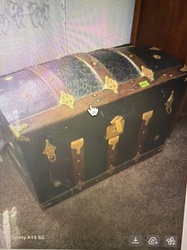
Late 19th-Century Dome Top Steamer Trunk

Antique Furniture / Travel Luggage

AI Estimated Value

·Not an official valuation·Verify before acting

$150-$300

As of June 10, 2026

AI Item Analysis

·AI can make mistakes·Verify before acting
This is a vintage wood and metal-bound steamer trunk, likely dating from the late 19th to early 20th century. The piece features a characteristic dome top (or barrel top) construction, designed to prevent other luggage from being stacked on top of it during ship or rail travel. The exterior is composed of high-relief wooden slats cross-reinforced with metal bands and rivets. The main body appears to be covered in a dark, weathered canvas or vulcanized fiber over a wooden frame, typical of the Victorian era. A notable distinguishing feature is the hand-painted or stenciled initials 'D M' centered on the lid, indicating a specific historical owner. The hardware includes a central metal lock mechanism and heavy-duty metal straps with buckle-style fasteners flanking the center. In terms of condition, the item shows significant signs of age and heavy use. There is extensive surface abrasion, peeling of the outer covering, and significant patina/corrosion on the metallic components. The wooden slats show chipping and dry rot in certain areas, particularly around the corners and edges. The leather straps used for the buckles appear brittle and partially disintegrated, which is common for organic materials of this age. No specific manufacturer's stamp is visible from this angle, though such markings are often found on the interior paper lining or the lock plate. Despite the wear, the trunk retains its structural integrity and represents a classic example of industrial-age craftsmanship intended for rugged long-distance transit.
AI Appraisal Report

·AI can make mistakes·Verify before acting
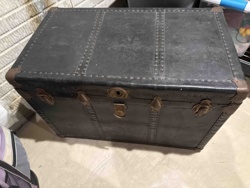
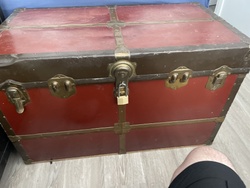
I have examined the provided images of this late 19th-century dome top steamer trunk. The piece displays classic Victorian-era construction, featuring high-relief wooden slats (likely oak or pine) and a canvas-covered body. The 'D M' monogramming suggests personal provenance, though without a linked historical figure, it serves primarily as a decorative element. My visual assessment confirms the item is authentic to the period, noted by the specific oxidation patterns on the metal strapping and the style of the lock plate hardware. The condition is poor to fair; the significant degradation of the leather straps and clear signs of dry rot and peeling significantly lower its utility and secondary market value. While dome top trunks are aesthetically desirable, they are common in the current antiques market. Comparables in similar 'as-is' condition typically sell at rural auctions or through private sales for low three-figure amounts. Retaining the original interior lithographs or a manufacturer's label (e.g., Taylor or Goyard—though this does not appear to be high-luxury) would bolster the price. The primary value lies in its potential as a restoration project or a rustic decor piece. Limitations: A physical inspection is required to determine if the wood rot is structurally compromising or if common pests like woodworm are present. I cannot verify the functionality of the lock mechanism or the presence of an interior tray without a hands-on examination. Full authentication would require checking the lock plate for a serial number and verifying the substrate material under the canvas.

Get your items appraised

Instant estimates of your treasures with AI-powered appraisals

Browse More Appraisals