AI estimate as of August 13, 2025 · verify with a professional before acting
AI-Generated · Verify before acting
Everything on this page is generated by AI for informational purposes only. AI can make mistakes — the AI may misidentify items or misattribute them (artist, maker, brand, designer, origin, era). This is not an official valuation and should not be used for insurance, sale, tax, estate, legal, or lending purposes — or any decision requiring a certified appraisal. It is not an authoritative claim about any person, brand, or rights holder — do not share or rely on it as a factual statement about a third party. Always consult qualified professionals before making financial decisions.
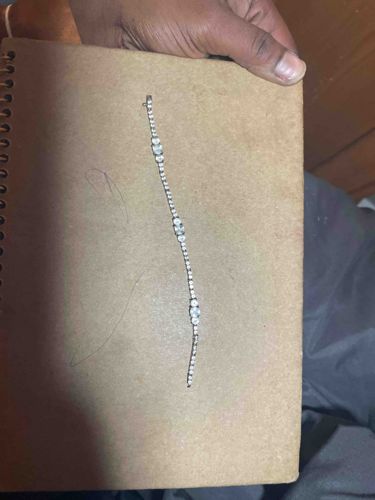
This item is a slender, flexible bracelet, likely a tennis bracelet, approximately 6-7 inches in length, constructed from a silver-toned metal, possibly sterling silver, white gold, or platinum, or a less precious alloy such as rhodium-plated brass for costume jewelry. The bracelet features a continuous linear arrangement of small, clear, round brilliant-cut stones, which are likely diamonds or diamond simulants like cubic zirconia, set closely together along its entire length. Interspersed along this chain of smaller stones are three larger, oval-shaped clear stones, evenly spaced, introducing a subtle design variation. Each of these larger oval stones appears to be surrounded by a halo or cluster of even smaller round stones, enhancing their visual impact and creating additional sparkle. The setting style for all stones appears to be prong-set, which allows maximum light to enter the stones, thereby enhancing their brilliance. The clasp mechanism is visible at one end, appearing to be a simple lobster clasp or a similar secure closure, consistent with bracelet designs meant for everyday wear or special occasions. There are no readily visible maker's marks or distinguishing hallmarks from the provided image. The overall condition appears good, with no obvious signs of missing stones or significant damage; however, the metal might benefit from cleaning to restore its full luster. The design suggests a classic, elegant aesthetic, popular since the mid-20th century, particularly for diamond or 'tennis' bracelets.
AI Appraisal Report
Upon examining the provided image of this slender, flexible bracelet, I observe a classic design reminiscent of a tennis bracelet, approximately 6-7 inches in length. The metal appears silver-toned, but without physical examination, its composition (sterling silver, white gold, platinum, or base metal) remains unconfirmed. The numerous small, clear, round brilliant-cut stones set along its length could be diamonds or simulants like cubic zirconia. The three larger, oval-shaped clear stones, each surrounded by a halo of smaller stones, are a notable design feature. All stones appear prong-set, which is favorable for brilliance. The clasp appears to be a standard secure closure. The overall condition seems good, with no obvious missing stones or significant damage, though a cleaning would enhance its luster.
Authenticity verification is severely limited without in-person examination. From the image alone, I cannot definitively determine if the stones are diamonds or simulants, nor can I ascertain the metal purity. The brilliance of the stones suggests good quality, but visual inspection cannot differentiate between high-grade simulants and actual diamonds.
Market conditions for "tennis" style bracelets are consistently strong due to their classic appeal. If the stones are genuine diamonds and the metal is precious (e.g., 14k white gold), the value would be substantial. However, if they are simulants in a base metal, the value would be significantly lower, often in the realm of costume jewelry. There is no discernible rarity from the design itself; similar styles are mass-produced with both genuine and simulated materials.
Factors significantly impacting value include: stone type (diamond vs. simulant), stone quality (cut, clarity, color, carat weight for diamonds), metal purity, and any potential designer provenance (not identifiable from the image).
For full authentication, a physical examination is crucial. This would involve diamond testing (e.g., thermal conductivity, reflectivity tests), microscopic examination of inclusions, and metal purity testing (e.g., acid tests, XRF analysis), as well as searching for hallmarks. Without these, any valuation remains an educated estimate based on the *potential* for genuine materials.