AI estimate as of July 31, 2025 · verify with a professional before acting
AI-Generated · Verify before acting
Everything on this page is generated by AI for informational purposes only. AI can make mistakes — the AI may misidentify items or misattribute them (artist, maker, brand, designer, origin, era). This is not an official valuation and should not be used for insurance, sale, tax, estate, legal, or lending purposes — or any decision requiring a certified appraisal. It is not an authoritative claim about any person, brand, or rights holder — do not share or rely on it as a factual statement about a third party. Always consult qualified professionals before making financial decisions.
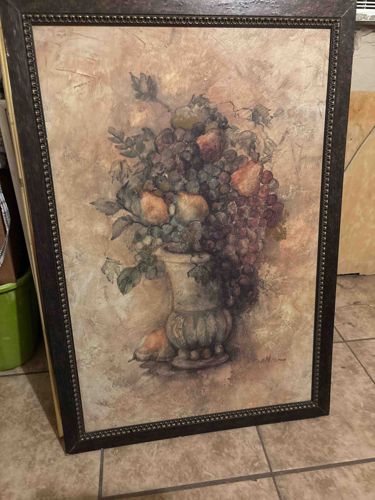
This item is a framed, decorative wall art piece featuring a still-life composition of fruit in a vase. The artwork appears to be a print or a type of embellished canvas transfer, rather than an original painting, due to the visible texture that seems applied or manufactured to mimic brushstrokes and the overall consistent finish. The central imagery depicts a classic arrangement of grapes, pears, and possibly other unidentifiable fruits overflowing from an ornate, classical-style urn or vase. The color palette is rich and earthy, dominated by deep purples, greens, oranges, and browns for the fruit and foliage, set against a mottled, light brown, beige, and cream background that exhibits an intentional distressed or textured appearance, likely designed to resemble aged plaster or fresco. The background also shows subtle hints of what could be a crackle finish or a deliberately created 'aged' look. The frame is a prominent feature, constructed from what appears to be wood or a composite material, finished in a dark, possibly bronzed or antiqued black color with a slightly metallic sheen. It features a decorative beaded inner lip bordering the artwork and a broader, flat outer profile, suggesting a transition from traditional to possibly transitional interior design styles. The overall size appears substantial, suitable for a focal point on a wall. There are no discernible artist signatures or manufacturer marks visible in the provided image. The condition appears good overall, with no obvious signs of significant damage such as tears, significant scuffs, or frame separation, though the exact condition of the surface cannot be fully assessed without closer inspection. The aesthetic suggests it belongs to a more contemporary decorative art period, likely post-2000, produced for mass-market home decor.
AI Appraisal Report
I have carefully examined the provided image of the Framed Still Life Fruit Print. From this visual assessment, the item appears to be a mass-produced decorative wall art piece, likely a print on canvas or an embellished reproduction, given the visible texture designed to mimic brushstrokes and the consistent finish. The distressed background also points to an manufactured aged look rather than genuine antiquity. The frame, a dark-finished wood or composite, complements the piece but reinforces its decorative, mass-market origin.
Based on the image, the condition appears good, with no obvious signs of significant damage like tears, scuffs, or frame separation. However, without physical inspection, I cannot ascertain the exact surface condition, any minor abrasions, or the integrity of the frame's joints. Authenticity as an original artwork is definitively ruled out; this is a decorative reproduction.
Market conditions for this type of decorative art are stable but generally low value. Comparables would include similar framed decorative canvas prints or wall art sold through large retailers, home decor stores, or online marketplaces. Demand exists for such pieces to fill decorative needs in homes, but rarity is non-existent as they are mass-produced.
Factors significantly impacting value are its nature as a reproduction and its mass-market appeal. Its primary value is decorative. Without an artist's signature, provenance, or unique characteristics, its value remains purely utilitarian as a home decor item.
Limitations: My assessment is based solely on the provided image. A full authentication process, while unnecessary for a decorative print of this nature, would typically involve in-person examination to confirm print medium, surface embelilshments, and frame construction details. Scientific testing (e.g., pigment analysis) and provenance documentation would only be relevant for an item claimed to be an original artwork.