These notes were written by the person who submitted this item. Appraiser.AI has not verified them, and the AI's identification and estimate may rely on them.
AI Estimated Value
Not an official valuation
$5 - $15
AI estimate as of November 19, 2025 · verify with a professional before acting
AI-Generated · Verify before acting
Everything on this page is generated by AI for informational purposes only. AI can make mistakes — the AI may misidentify items or misattribute them (artist, maker, brand, designer, origin, era). This is not an official valuation and should not be used for insurance, sale, tax, estate, legal, or lending purposes — or any decision requiring a certified appraisal. It is not an authoritative claim about any person, brand, or rights holder — do not share or rely on it as a factual statement about a third party. Always consult qualified professionals before making financial decisions.
This analysis also relies on unverified notes provided by the user, which may be incomplete or inaccurate and could affect the result.
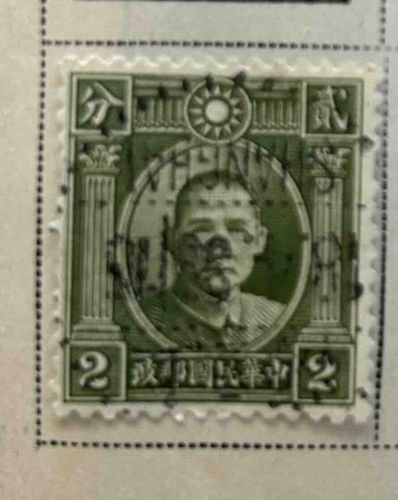
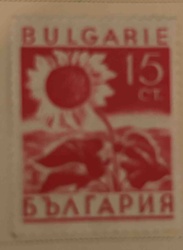
This item is a postage stamp from the Republic of China, featuring a portrait of Chiang Kai-shek in the center. The stamp is predominantly green in color, with details rendered in darker green and black ink. It has a rectangular shape with perforations around all four edges, indicating it was intended to be separated from a larger sheet. The central portrait of Chiang Kai-shek is encircled, framed by two ornate columns on either side. Above the portrait, a stylized sun emblem, a common symbol of the Kuomintang (KMT) and the Republic of China, is prominently displayed. In the upper left corner, the Chinese character for 'Fen' (分) is visible, while the upper right corner shows the character for 'two' (貳). The denomination '2' is also clearly printed in the lower left and lower right corners, reinforcing its value as two Fen. At the bottom, below the portrait, there are Chinese characters which translate to '中華民國郵政' (Taiwan, Republic of China Post). The stamp exhibits some signs of use, including a clear circular cancellation mark over the portrait, suggesting it has been postally used. The perforations appear largely intact, though some minor fraying might be present upon closer inspection. The printing quality appears to be consistent with philatelic items from the mid-20th century. The intricate detailing of the columns and the sun emblem suggests a standard level of craftsmanship for government-issued stamps of that era. Given the context of Chinese stamps, this item likely dates from the period when Chiang Kai-shek was a prominent leader in the Republic of China, potentially from the 1940s or early 1950s.
AI Appraisal Report
I have carefully examined the provided image and information regarding this Republic of China 2 Fen green stamp featuring Chiang Kai-shek. Visually, the stamp appears authentic, consistent with known issues from the mid-20th century, likely dating from the 1940s-1950s. The design elements—Chiang Kai-shek's portrait, the stylized sun emblem, Chinese characters for 'Fen' and 'two,' and '中華民國郵政'—all align with standard philatelic examples of this period.
The condition, as observed, shows clear signs of postal use with a distinct circular cancellation mark over the portrait. The perforations seem largely intact, though minor fraying is noted, which is common for used stamps. The printing quality appears consistent for the era. This issue is generally quite common, and used examples typically hold modest value. While historically significant, these stamps were produced in large quantities and are readily available in the philatelic market.
Market conditions for this specific stamp are stable but not high-demand for used examples. Comparables suggest that common, used stamps from this series typically fetch prices in the low single-to-double-digit dollar range. Rarity is not a significant factor here; thus, demand is primarily driven by collectors interested in Chinese philately or stamps depicting historical figures. Unused, mint condition examples would command higher prices, as would specific varieties or errors, which are not apparent here.
It is crucial to note the limitations of an appraisal based solely on images. While the visual cues strongly suggest authenticity, a definitive verification would require an in-person examination. This would allow for inspection of paper type, watermarks (if any), gum condition (though less relevant for a used stamp), printing method details under magnification, and assessment of any hidden flaws or repairs. Provenance documentation, while helpful for rare items, is less critical for a common stamp like this. Without physical inspection, I cannot rule out the possibility of a high-quality counterfeit, although the observable details do not immediately suggest one.