AI estimate as of December 16, 2025 · verify with a professional before acting
AI-Generated · Verify before acting
Everything on this page is generated by AI for informational purposes only. AI can make mistakes — the AI may misidentify items or misattribute them (artist, maker, brand, designer, origin, era). This is not an official valuation and should not be used for insurance, sale, tax, estate, legal, or lending purposes — or any decision requiring a certified appraisal. It is not an authoritative claim about any person, brand, or rights holder — do not share or rely on it as a factual statement about a third party. Always consult qualified professionals before making financial decisions.
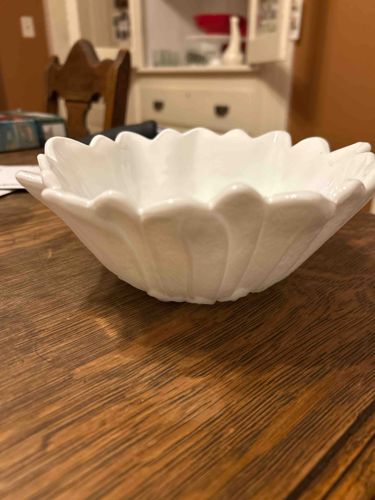
This is a white milk glass bowl with a distinct scalloped or fluted rim and body design. The bowl is circular in form, with the exterior featuring vertical flutes or ribs that ascend from the base, creating a visual texture that evokes the appearance of a flower's petals or a pleated fabric. The rim itself is irregularly shaped, following the undulations of these flutes, giving it a soft, wavy edge rather than a smooth, uniform one. The interior of the bowl appears smooth and glossy, contrasting with the textured exterior. The material is opaque white glass, typical of milk glass, which gives it a soft, luminous quality. Based on typical milk glass production, it is likely pressed glass. There are no visible chips, cracks, or significant abrasions in the provided image, suggesting good overall condition. Without maker's marks, specific attribution is difficult, but this style is characteristic of mid-20th-century American glass manufacturers like Fostoria, Fenton, or Westmoreland, who produced numerous milk glass items with similar decorative fluting and scalloped edges. The craftsmanship appears to be of good quality, with consistent fluting and a well-formed rim. The item has a classic, timeless aesthetic often associated with vintage dinnerware or decorative serving pieces.
AI Appraisal Report
Based on my visual examination of the provided image, this milk glass scalloped bowl appears to be in very good condition. I observe no visible chips, cracks, or significant abrasions on the surface, which is crucial for maximizing value in vintage glass. The consistent fluting and well-formed scalloped rim indicate quality craftsmanship typical of American milk glass manufacturers. Authenticity, based solely on this image, strongly points to it being a product of the mid-20th century. Its style is highly consistent with designs produced by companies like Fostoria, Fenton, or Westmoreland, all known for their numerous milk glass offerings.
Market conditions for common milk glass pieces, even those in excellent condition, are generally stable but not experiencing significant appreciation. While popular for their vintage charm and versatility, similar bowls are readily available on secondary markets, which impacts rarity. Demand is moderate, driven by collectors of specific patterns or general buyers looking for decorative or serving pieces. The lack of distinct maker's marks, which is common for many milk glass items of this era, limits its potential for higher value, as specific attribution to a premium manufacturer (like some Fenton patterns) cannot be confirmed without further examination.
Factors significantly impacting its value include its excellent condition and classic appeal. However, the absence of a unique or highly sought-after pattern and the general abundance of similar milk glass items keep its value in a modest range. For full authentication and definitive attribution, an in-person examination would be necessary to search for any faint molded marks, examine the glass quality more closely for specific characteristics (e.g., opalescence, weight), and potentially compare it against known manufacturer catalogs. Provenance documentation, if available, would also greatly assist in confirming its origin.