These notes were written by the person who submitted this item. Appraiser.AI has not verified them, and the AI's identification and estimate may rely on them.
AI Estimated Value
Not an official valuation
$75-125
AI estimate as of August 9, 2025 · verify with a professional before acting
AI-Generated · Verify before acting
Everything on this page is generated by AI for informational purposes only. AI can make mistakes — the AI may misidentify items or misattribute them (artist, maker, brand, designer, origin, era). This is not an official valuation and should not be used for insurance, sale, tax, estate, legal, or lending purposes — or any decision requiring a certified appraisal. It is not an authoritative claim about any person, brand, or rights holder — do not share or rely on it as a factual statement about a third party. Always consult qualified professionals before making financial decisions.
This analysis also relies on unverified notes provided by the user, which may be incomplete or inaccurate and could affect the result.
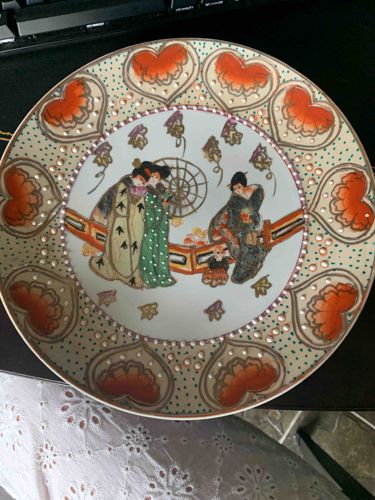
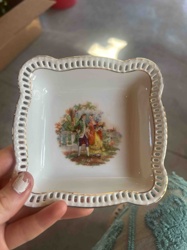
This is a hand-painted decorative ceramic plate, likely made of porcelain, featuring a central scene of what appears to be three Japanese-style figures, possibly geishas or noblewomen, interacting in an interior or garden setting. One figure is kneeling, and two are standing, with a small animal, possibly a cat or dog, near the kneeling figure. The background includes architectural elements like a fence or railing and what might be a traditional window or screen with radial spokes. The figures are depicted in vibrant, flowing kimonos with discernible patterns, showcasing detailed brushwork.
The plate's border is intricate, composed of alternating large heart-shaped cartouches with elaborate floral or feather-like motifs in shades of muted orange/red and smaller sections filled with a stippled or dotted pattern in light green against a cream background. The rim of the plate is defined by a thin, dark line. The overall color palette includes rich reds, greens, yellows, and browns for the figures, set against a lighter cream and off-white background in the center. The raised texture of some of the dots on the border suggests possible moriage or enamel work, adding to the dimensionality. The craftsmanship appears to be of good quality, with fine lines and attention to detail in the painting. No visible damage such as cracks, chips, or significant wear is apparent from the image, suggesting it has been well-preserved, likely used for display rather than functional dining. The style points towards an East Asian, specifically Japanese, influence, and given the hand-painted nature and detailed artistry, it could date from the early to mid-20th century. There are no visible maker's marks or signatures in the provided view to confirm origin or artist.
AI Appraisal Report
Upon examining the images of this hand-painted decorative plate, I note its high-quality craftsmanship and compelling Japanese-style figural scene. The central depiction of three figures in elaborate kimonos is rendered with fine brushwork, and the intricate border, featuring alternating cartouches and what appears to be moriage or enamel dot-work, adds significant visual interest and dimensionality. The overall condition appears excellent, with no visible chips, cracks, or significant wear, which is a major factor in its value. Based on the style, color palette, and decorative techniques, the piece is consistent with Japanese export ware from the early to mid-20th century, likely from the Taisho (1912-1926) or early Showa (1926-1989) period.
The market for such decorative plates is stable, with consistent demand from collectors of Japanese ceramics and Asian art. Comparables of similar quality and condition from this era, without a specific maker's mark, typically sell in the range provided. The plate's value is enhanced by its excellent preservation and detailed artistry. However, its value is limited by the absence of a discernible maker's mark or artist's signature, which prevents attribution to a more sought-after kiln or artist like Satsuma or Kutani, which could dramatically increase its worth.
It is crucial to note that this appraisal is based solely on visual examination of images. A definitive authentication would require in-person inspection to confirm the ceramic body, examine the base for any hidden marks, and verify the moriage technique. Without physical handling and provenance documentation, the precise origin and age cannot be fully confirmed.