AI estimate as of September 2, 2025 · verify with a professional before acting
AI-Generated · Verify before acting
Everything on this page is generated by AI for informational purposes only. AI can make mistakes — the AI may misidentify items or misattribute them (artist, maker, brand, designer, origin, era). This is not an official valuation and should not be used for insurance, sale, tax, estate, legal, or lending purposes — or any decision requiring a certified appraisal. It is not an authoritative claim about any person, brand, or rights holder — do not share or rely on it as a factual statement about a third party. Always consult qualified professionals before making financial decisions.
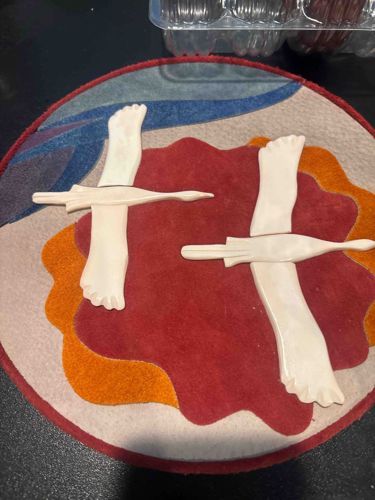
This item is a circular, quilted pot holder or hot pad, approximately 12-14 inches in diameter, featuring an abstract, colorful design. The base layers of the textile are composed of various felted or fleece-like fabrics in shades of red, orange, white, blue, and light grey. These layers are cut in organic, wavy shapes and appear to be appliqued or pieced together, creating a vibrant, irregular pattern that suggests flowing liquids or land formations. The edges are finished with a red binding, indicating careful construction. On top of this textile base, two ivory-colored, possibly resin or plastic, stylized 'legs' or 'feet' with attached elongated 'bars' resembling rolling pins are adhered. Each 'leg' is roughly 6-8 inches long and features defined toes. The 'rolling pins' are positioned horizontally, crossing the lower part of each 'leg'. These white elements provide a stark, almost surreal contrast to the soft, colorful background. There are no visible maker's marks or signatures. The overall condition appears good, with no obvious tears or significant stains on the fabric. The white elements show no visible damage or significant discoloration, maintaining a clean, off-white hue. The craftsmanship suggests a handmade or small-batch production, with attention paid to the fabric layering and the secure attachment of the three-dimensional elements. The piece appears to be a decorative and functional item, likely from the late 20th or early 21st century, given its contemporary aesthetic and materials.
AI Appraisal Report
Upon visual examination of the provided image, this circular quilted pot holder, approximately 12-14 inches in diameter, presents in good overall condition. The vibrant fabric layering of felted or fleece-like materials in organic shapes appears well-preserved, with no obvious tears or significant staining from what I can discern. The red binding is intact, suggesting careful construction. The unique ivory, stylized 'legs' with 'rolling pin' accents are clearly attached, and their clean, off-white hue indicates no notable damage or discoloration. The craftsmanship points to a handmade or small-batch production, likely dating from the late 20th to early 21st century.
Assessing authenticity purely from images presents limitations. While the piece appears genuine as a handmade item, without physical examination, I cannot verify material composition (e.g., specific felt/fleece types, or if the 'legs' are indeed resin/plastic), the security of the attachments, or detect subtle fabric wear/fading not visible in photographs. An in-person inspection would allow for tactile assessment of material quality and structural integrity. Provenance documentation, such as artist information or purchase records, would be crucial for attributing the piece to a specific maker, which could significantly impact value if it’s by a recognized textile artist. Without such documentation, it is valued as anonymous folk art or decorative textile.
Market comparables for contemporary quilted art or 'art quilts' by established artists can range significantly, often into the hundreds or thousands, but for anonymous, decorative functional items, the market is more modest. The whimsical and surrealistic elements are a unique selling point. Demand for such specific, quirky decorative items is niche, and its rarity is moderate; while unique, it's not by a known artist. Therefore, its value is primarily as a decorative, artful hot pad or small wall hanging rather than a collectible art piece. Factors impacting value include its good condition, unusual design, and evident craftsmanship. Its anonymous nature and likely practical function keep the value in the lower range.