AI estimate as of September 14, 2025 · verify with a professional before acting
AI-Generated · Verify before acting
Everything on this page is generated by AI for informational purposes only. AI can make mistakes — the AI may misidentify items or misattribute them (artist, maker, brand, designer, origin, era). This is not an official valuation and should not be used for insurance, sale, tax, estate, legal, or lending purposes — or any decision requiring a certified appraisal. It is not an authoritative claim about any person, brand, or rights holder — do not share or rely on it as a factual statement about a third party. Always consult qualified professionals before making financial decisions.
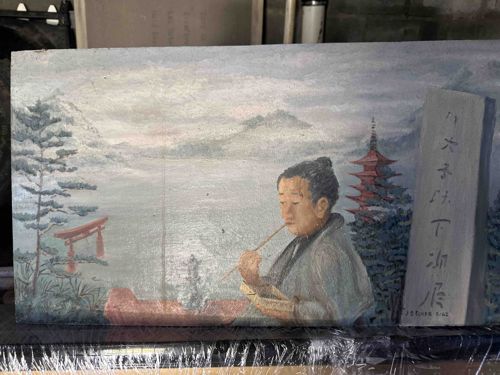
This item is an oil painting or acrylic painting on a rigid surface, likely a wooden panel or a hardboard, depicting a serene Japanese landscape. The painting features a male figure in traditional attire, possibly a monk or scholar, seated and engaged in an activity that involves a thin stick-like object, perhaps writing or painting. He has dark hair tied back and is wearing a muted grey-green robe. The background is a detailed landscape with soft, rolling mountains under a cloudy sky, suggesting a calm or misty atmosphere. To the left, a solitary pine tree stands tall, and a red torii gate is visible, partially submerged in what appears to be water or a low-lying misty area, hinting at a shrine or sacred place. On the right, a distinctive multi-tiered red pagoda rises amidst dense green-blue foliage, suggesting a temple complex. A large, grey, upright rectangular stone with Japanese calligraphy is prominently positioned in the right foreground, acting as a significant visual element within the composition. At the bottom right corner, a very faded signature is discernible, appearing to read "J S K R." and below it "R. '62", suggesting a possible artist's signature and a year, '62, which could indicate the painting was created in 1962. The color palette is generally subdued, with greens, blues, greys, and earthy tones, punctuated by the vibrant red of the torii gate and the pagoda. The brushstrokes are visible, indicating a painterly style. The surface shows some signs of age and minor wear, with slight discoloration or patina consistent with its estimated age. The painting appears to be unframed and the edges suggest it may have been cut from a larger piece or prepared as a panel for painting. The item is currently enclosed in clear plastic wrapping, which obscures some edges and surface details but protects it from further damage.
AI Appraisal Report
Based on my examination of the provided image of this Japanese Scenic Painting with Figure and Pagoda, I assess its condition as good, consistent with its estimated age. The discernible signature 'J S K R. R. '62' suggests a creation date of 1962, which aligns with the observed patina and slight discoloration. The painterly style with visible brushstrokes indicates an original work rather than a print. The clear plastic wrapping, while protective, does limit my ability to fully assess surface texture, actual dimensions, and the extent of any wear or discoloration on the edges.
Market conditions for unsigned or lesser-known artist paintings of this style can be variable. While decorative, without a prominent artist's name, the value leans towards its aesthetic appeal and the vintage market for Asian-inspired art. Comparable works by unknown artists from the mid-20th century typically fetch modest prices. Demand exists for decorative art that complements various home decors, but this piece isn't rare in terms of its subject matter or technique. The lack of framing also impacts its immediate display value.
The primary factor impacting value is the absence of an established artist's provenance. Without a recognized name, the painting's value is largely decorative. For full authentication and a more precise appraisal, an in-person examination would be crucial to verify the medium (oil or acrylic), inspect the rigid surface for any markings or stamps, and closely scrutinize the signature for legibility and comparison against known works by artists with similar monikers. Additionally, any provenance documentation, such as purchase receipts or exhibition records, would significantly enhance its authenticity and potential value beyond decorative appeal.