AI estimate as of December 9, 2025 · verify with a professional before acting
AI-Generated · Verify before acting
Everything on this page is generated by AI for informational purposes only. AI can make mistakes — the AI may misidentify items or misattribute them (artist, maker, brand, designer, origin, era). This is not an official valuation and should not be used for insurance, sale, tax, estate, legal, or lending purposes — or any decision requiring a certified appraisal. It is not an authoritative claim about any person, brand, or rights holder — do not share or rely on it as a factual statement about a third party. Always consult qualified professionals before making financial decisions.
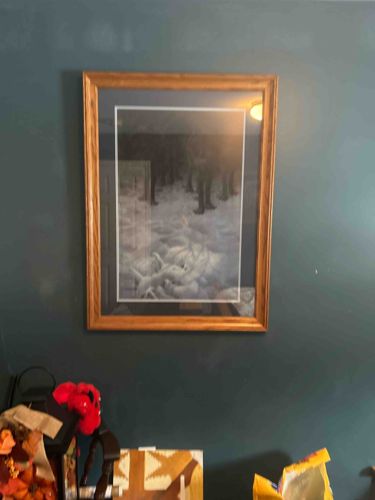
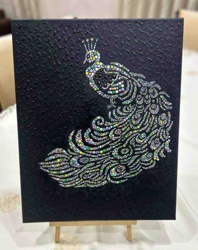
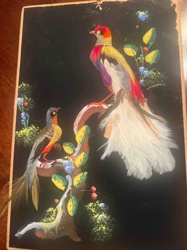
The item is a framed art print, likely a limited edition or open edition print, depicting a scene of wolves in a snowy landscape. The overall composition shows the lower half of numerous wolf bodies, specifically their legs and paws, partially obscured by darkness in the background. The foreground is dominated by a substantial amount of swirling, unevenly piled snow, which appears to have a sculptural quality, creating focal points of light and shadow. The wolves' fur appears to be in shades of grey and brown, blending with the muted tones of the winter environment. The print is housed in a horizontally oriented wooden frame made of a light to medium oak or similar wood with a visible grain, suggesting a natural finish. The frame itself has a simple, slightly rounded profile, a classic and unfussy design. Inside the frame, there is a prominent white matboard, which effectively isolates the artwork and provides a clean border, enhancing the visual depth and protecting the print from direct contact with the glass. A strong reflection of a warm, yellow light source (possibly an incandescent bulb or fixture) is visible on the upper right side of the protective glazing, indicating the presence of glass or acrylic. The artistic style leans towards realistic wildlife art, known for meticulous detail in capturing animal anatomy and environmental textures. Given the subject matter and apparent execution, it strongly resembles the work of wildlife artist Carl Brenders, specifically his 'Wolfpack' series, which often features wolves partially obscured or moving through dense environments or snow. The print appears to be in good overall condition, with no immediately discernible damage to the frame or mat. The reflective glare makes it difficult to assess the exact condition of the print surface itself, but no obvious creases, tears, or significant discoloration are apparent. The framing style suggests a contemporary to late 20th/early 21st-century aesthetic. The quality of the reproduction and framing appears to be standard for commercially available art prints.
AI Appraisal Report
Based on my visual examination of 'The Wolfpack' by Carl Brenders, I assess this framed art print to be in good overall condition. The wooden frame is simple yet elegant, complementing the realistic wildlife art. The white matboard enhances the artwork and appears clean. I can detect no obvious damage to the frame or mat. While a strong reflection obscures the print surface, there are no visible creases, tears, or significant discoloration. The artistic style is characteristic of Carl Brenders, a well-regarded wildlife artist known for his detailed depictions. This piece, likely an open or limited edition print, fits within his 'Wolfpack' series.
Market conditions for open edition wildlife prints, even by recognized artists, typically place their value in the low to moderate range. Limited edition prints, if this is one, would command slightly higher values depending on the edition size and the artist's current market. However, without visible edition numbers or a signature, it's difficult to confirm this. Comparable framed prints by Brenders generally sell for $100-$400 on the secondary market, with the higher end reserved for signed, numbered, or larger format limited editions.
Demand for wildlife art remains steady but is not typically speculative. Rarity is low for open edition prints. The primary factors impacting value here are the artist's reputation, the print's condition, and crucially, its authenticity and edition specifics.
My primary limitation is the lack of physical examination. While the image strongly suggests a Carl Brenders print, definitive authentication would require an in-person inspection to verify the signature (if any), edition number (if limited), and the print's true quality and condition beneath the glare. Provenance documentation, such as a certificate of authenticity or original purchase receipts, would also be instrumental in fully verifying its authenticity and edition details, thereby impacting its final valuation.