These notes were written by the person who submitted this item. Appraiser.AI has not verified them, and the AI's identification and estimate may rely on them.
AI Estimated Value
Not an official valuation
$300 - $600
AI estimate as of August 29, 2025 · verify with a professional before acting
AI-Generated · Verify before acting
Everything on this page is generated by AI for informational purposes only. AI can make mistakes — the AI may misidentify items or misattribute them (artist, maker, brand, designer, origin, era). This is not an official valuation and should not be used for insurance, sale, tax, estate, legal, or lending purposes — or any decision requiring a certified appraisal. It is not an authoritative claim about any person, brand, or rights holder — do not share or rely on it as a factual statement about a third party. Always consult qualified professionals before making financial decisions.
This analysis also relies on unverified notes provided by the user, which may be incomplete or inaccurate and could affect the result.
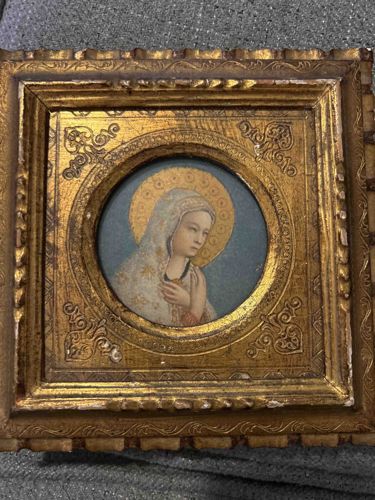
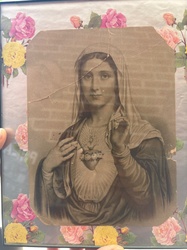
This item is a framed devotional painting, likely a miniature or small-scale work, depicting the Virgin Mary. The central image is an oval portrait of Mary, rendered with a serene expression, a light complexion, and downturned eyes, suggesting contemplation or humility. She wears a white or off-white veil, possibly with gold or light-colored embroidered details, covering her head and shoulders. A gold halo, distinguished by multiple concentric circles and delicate dot patterns, encircles her head, signifying her sanctity. Her hands are clasped over her chest in a gesture of prayer or reverence. The background of the portrait is a soft, sky-blue color. The painting itself exhibits some surface wear and minor discoloration, consistent with age. This central oval is set within a robust, rectangular wooden frame, which appears to be carved and gilded. The frame features intricate relief ornamentation, including foliate scrolls and possibly acanthus leaves, particularly visible in the corners of the inner oval border and along the outer rectangular edge. The gold gilding on the frame shows significant signs of age, including chipping, flaking, and loss of gesso, revealing the underlying red bole and wood in several areas, indicative of expected wear for an antique piece of this type. The craftsmanship of both the painting and the frame suggests a European, likely Italian, origin, possibly from the Renaissance or Baroque period, or a later revivalist style. The overall condition of the frame, with its visible distressing and patina, contributes to its antique aesthetic. The size appears to be relatively small, intended for personal devotion or a cabinet display. The details of the halo and the style of portrayal suggest it could be a copy or interpretation of earlier masterworks, given the association with 'Vittorio Alinari' which is a photographic studio known for reproductions of art.
AI Appraisal Report
Upon examining the provided image of the framed devotional painting of the Virgin Mary, I can offer the following appraisal. The painting itself, depicting a serene Virgin with a halo, appears to be a devotional piece, possibly a copy or interpretation given the association with 'Vittorio Alinari,' a photographic studio known for fine art reproductions. The oval portrait shows some surface wear and minor discoloration, which is consistent with age. The elaborate carved and gilded wooden frame, with its foliate scrolls and acanthus leaves, exhibits significant age and wear, including chipping, flaking, and loss of gesso revealing the red bole. This wear, while substantial, contributes to its antique aesthetic. The craftsmanship suggests a European origin, possibly Italian. The size appears suitable for personal devotion or cabinet display.
Market conditions for devotional art can vary widely. While original works from the Renaissance or Baroque period would command significant values, the stylistic cues and particularly the 'Vittorio Alinari' association strongly suggest this is a high-quality reproduction, likely from the late 19th or early 20th century, which significantly impacts its market value. Demand for good quality antique devotional items remains, but rarity is diminished if it's a reproduction. Factors impacting value include the frame's condition, which, despite its wear, retains its decorative appeal, and the aesthetic quality of the reproduction itself.
My valuation is based on the strong likelihood of this being an antique reproduction rather than an original masterwork. Without physical examination, I cannot definitively determine the medium or precise age of the painting itself; it could be a print, hand-colored print, or a hand-painted copy. To fully authenticate, an in-person examination by a conservator to assess the paint layers, pigments, and substrate would be crucial. Provenance documentation, beyond the Alinari name, would also be vital for a more definitive appraisal of its authenticity and historical significance.