AI estimate as of September 20, 2025 · verify with a professional before acting
AI-Generated · Verify before acting
Everything on this page is generated by AI for informational purposes only. AI can make mistakes — the AI may misidentify items or misattribute them (artist, maker, brand, designer, origin, era). This is not an official valuation and should not be used for insurance, sale, tax, estate, legal, or lending purposes — or any decision requiring a certified appraisal. It is not an authoritative claim about any person, brand, or rights holder — do not share or rely on it as a factual statement about a third party. Always consult qualified professionals before making financial decisions.
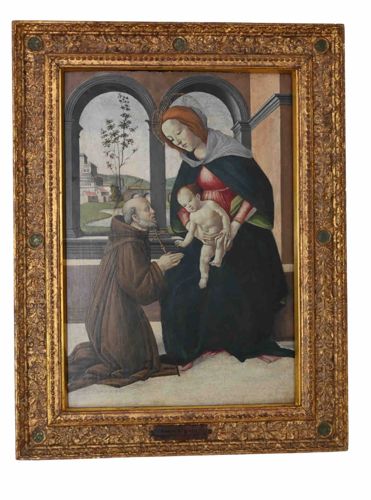
The item is a framed oil painting, depicting the Madonna and Child with Saint Francis. The painting is housed within a richly decorated, gilded wooden frame. The frame features intricate carved floral and foliate motifs, with some visible wear and minor losses to the gilding, suggestive of its age. There are darker, possibly patinated, recessed circular elements at each corner and along the midpoints of the frame's longer sides. The painting itself showcases a central composition with the Virgin Mary seated, holding the Infant Jesus on her lap. Mary is depicted wearing a dark blue or black cloak over a red garment, and a white head covering that partially obscures her auburn hair. A faint halo is visible above her head. The Infant Jesus is nude and is reaching out towards Saint Francis. Saint Francis, identifiable by his Franciscan habit, is kneeling to the left of the Virgin, looking reverently at the Child. He is depicted with a tonsure haircut and a beard, holding a crucifix in his hands. The background features two arched windows or doorways looking out onto a landscape with a sparse tree, buildings, and a distant hilly terrain, rendered in muted tones. The interior setting in which the figures are placed suggests an architectural space with classical elements, possibly in a loggia or niche. The overall color palette is subdued yet sophisticated, characteristic of Renaissance artistry. The style points to an Italian Renaissance origin, likely from the Quattrocento or early Cinquecento period. A small plaque is affixed to the lower center of the frame, but the text is not clearly legible from the image. The painting exhibits a smooth application of paint and a detailed, yet idealized, rendering of figures indicative of skilled craftsmanship. Minor surface irregularities and age-related craquelure may be present on the painted surface, though not distinctly visible at this resolution.
AI Appraisal Report
Based on my visual examination of the provided image, this framed oil painting, 'Madonna and Child with Saint Francis,' presents as a significant work of likely Italian Renaissance origin, potentially from the Quattrocento or early Cinquecento period. The composition, subdued yet sophisticated color palette, and idealized rendering of figures are highly consistent with the artistic conventions of that era. The visible wear on the richly decorated gilded frame is appropriate for its suggested age. The smooth application of paint and detailed craftsmanship point to a skilled artist. Condition appears good from the image, but minor surface irregularities, craquelure, and potential restoration would require in-person inspection.
Market conditions for authentic Renaissance works of this caliber are strong, driven by their rarity and historical significance. Comparable sales of attributed or authenticated Renaissance religious panels by significant artists or their workshops can command values in the mid-to-high six figures or more, particularly for compositions featuring the Madonna and Child. Demand is consistently high among major museums and private collectors.
However, a definitive assessment of authenticity and authorship is severely limited by image-based appraisal. The visible plaque, for instance, cannot be deciphered. To fully authenticate this piece, I would require a direct in-person examination to assess paint layers, pigment analysis, wood panel or canvas type, and underdrawing. Furthermore, comprehensive provenance documentation, including exhibition history and previous ownership, would be crucial. Scientific testing, such as infrared reflectography and X-radiography, would be essential to confirm age and uncover any hidden details or past alterations. Without these, the current valuation remains an estimate based on visual characteristics consistent with the period.