AI Appraisal Estimate

AI-generated estimates · not official valuations

From the user

What was submitted

Photo and notes provided by the user — not generated by AI

Submitted item photo
Submitted photo · May 26, 2026

User's notes

Money

AI analysis below

AI appraisal

AI analysis & estimate

AI-Generated · Verify before acting

Everything below is generated by AI for informational purposes only. AI can make mistakes — the AI may misidentify items or misattribute them (artist, maker, brand, designer, origin, era). This is not an official valuation and should not be used for insurance, sale, tax, estate, legal, or lending purposes — or any decision requiring a certified appraisal. It is not an authoritative claim about any person, brand, or rights holder — do not share or rely on it as a factual statement about a third party. Always consult qualified professionals before making financial decisions.

Note

This analysis also relies on unverified notes provided by the user, which may be incomplete or inaccurate and could affect the result.

Read the full disclaimer

AI Identification

·Not independently authenticated·Verify before acting

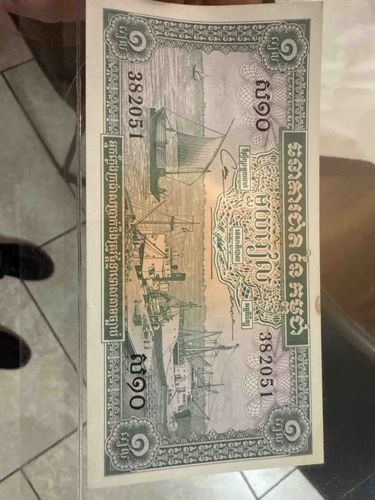
Cambodian 100 Riel Banknote (Year 1956)

Numismatics - International Banknotes

AI Estimated Value

·Not an official valuation·Verify before acting

$45.00 - $65.00

As of May 26, 2026

AI Item Analysis

·AI can make mistakes·Verify before acting
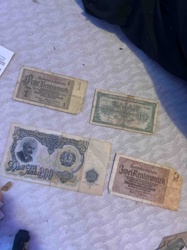
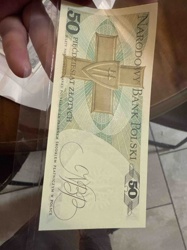
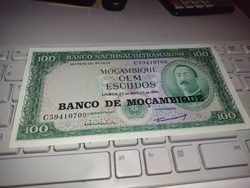
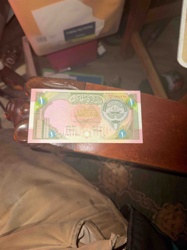
This is a 100 Riel banknote issued by the National Bank of Cambodia, specifically identified as part of the 1956 series. The note features a vertical orientation, printed on high-quality security paper with a primarily green and beige color palette. The central artwork depicts a harbor scene with traditional Khmer sailing vessels and a steamship, representing Cambodian commerce. The Khmer script is prominent throughout, with the denomination '១០០' (100) appearing in the corners and center. The serial number '382051' is printed twice in black ink. The reverse (not fully visible but indicated by the vertical layout) typically features a school scene. The note shows excellent craftsmanship with intricate guilloché patterns and fine-line engraving to prevent counterfeiting. Regarding condition, the note appears to be in very fine to extremely fine circulated condition; the edges are mostly sharp, though there is a noticeable brown spot or foxing on the right-hand margin and slight overall yellowing of the paper consistent with age. There are no obvious major tears or heavy creases visible, though slight horizontal bowing suggests it has been stored in a plastic sleeve. This series was used during the post-independence era under Prince Norodom Sihanouk.
AI Appraisal Report

·AI can make mistakes·Verify before acting
I have conducted a visual examination of this 1956 National Bank of Cambodia 100 Riel (Pick #6). This vertical series is highly regarded for its artistic representation of the post-independence era. The specimen displays the characteristic green and beige palette with crisp engraving visible in the guilloché patterns. Based on the images provided, I grade this note as Very Fine (VF) to Extremely Fine (EF). While the structural integrity remains strong with no major tears, the value is tempered by visible foxing/brown spotting on the right margin and general paper toning. These environmental factors prevent it from achieving a 'Uncirculated' premium. The market for Cambodian notes from this period remains stable, with high demand for examples that haven't been pressed or cleaned. Comparables for this specific serial range in similar grades have recently sold in the $40-$70 range. Authentic high-grade examples are becoming rarer as paper quality from this era is prone to deterioration in tropical climates. Please note that while the printing details and serial numbering appear consistent with genuine 1956 issues, a digital image cannot confirm paper texture, watermark depth, or the presence of chemical washing. A physical inspection is required to verify the 'feel' of the paper and confirm the watermark's authenticity. I recommend professional grading by PMG or PCGS to maximize liquidity and verify the note's original state, as the slight bowing suggests long-term storage in a plastic sleeve which should be checked for PVC content.

Get your items appraised

Instant estimates of your treasures with AI-powered appraisals

Browse More Appraisals