These notes were written by the person who submitted this item. Appraiser.AI has not verified them, and the AI's identification and estimate may rely on them.
AI Estimated Value
Not an official valuation
$40-75
AI estimate as of December 11, 2025 · verify with a professional before acting
AI-Generated · Verify before acting
Everything on this page is generated by AI for informational purposes only. AI can make mistakes — the AI may misidentify items or misattribute them (artist, maker, brand, designer, origin, era). This is not an official valuation and should not be used for insurance, sale, tax, estate, legal, or lending purposes — or any decision requiring a certified appraisal. It is not an authoritative claim about any person, brand, or rights holder — do not share or rely on it as a factual statement about a third party. Always consult qualified professionals before making financial decisions.
This analysis also relies on unverified notes provided by the user, which may be incomplete or inaccurate and could affect the result.
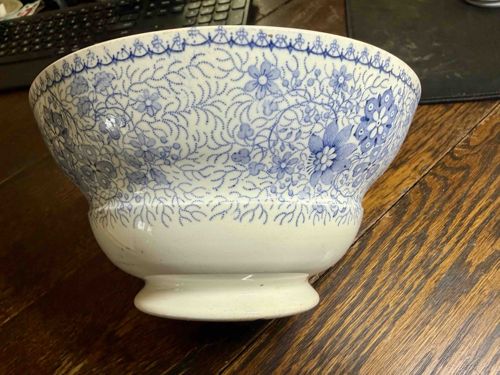
This is an antique or vintage transferware bowl, circular in form with a gently flared rim and a distinct footed base. The bowl measures approximately 7 inches in diameter and stands about 3.75 inches tall, as indicated by the user-provided context. It is constructed from ceramic, likely earthenware or ironstone, and features a classic blue and white color scheme. The primary decoration consists of an intricate, repeating floral and leafy pattern covering the majority of the bowl's exterior surface. The pattern includes various shades of blue, ranging from a lighter, almost dotted background texture to more solid, defined darker blue flowers. The rim is adorned with a delicate border featuring a scalloped or lace-like motif. Near the base, just above the foot, there is a band of simpler, stylized leafy or vine-like elements. The overall aesthetic suggests a late 19th or early 20th-century style, characteristic of transferware production from that period. There are no visible maker's marks or signatures in the provided image. The condition appears to be good for an item of its likely age, with no obvious chips, cracks, or significant repairs visible, though some minor age-related crazing or surface wear might be present upon closer inspection not possible from the image provided. The craftsmanship indicates a mass-produced but well-executed piece typical of the category, with clear and well-aligned transfer details. The footed design adds stability and a touch of elegance to the utilitarian form.
AI Appraisal Report
I have examined the provided image of this blue and white transferware bowl, which measures 7 inches in diameter and 3.75 inches in height. The bowl presents a classic aesthetic, featuring a detailed floral and leafy pattern and a scalloped rim, typical of late 19th or early 20th-century transferware. The ceramic material appears to be earthenware or ironstone.
Based on visual inspection, the condition appears good for its age, with clear transfer details and no immediately apparent chips, cracks, or significant repairs. However, without a physical examination, I cannot definitively rule out minor age-related crazing or subtle surface wear. The absence of a maker's mark in the image limits precise attribution, which is common for many utilitarian transferware pieces.
In terms of market conditions, blue and white transferware, while popular, is generally not rare unless associated with a particularly desirable pattern, renowned manufacturer, or historical significance. This bowl's design is attractive but appears to be a generic floral motif, which aligns with mass production of the era. The demand for such items is steady among collectors of antique dinnerware and decorative home accents, but it falls into a broad category of readily available pieces.
The lack of specific provenance and maker's marks, coupled with its common decorative style, means its value is primarily driven by its decorative appeal and condition. Factors impacting value positively include its overall intact state and charming pattern; negatively, the lack of known authorship or rarity. For full authentication and a definitive assessment of condition, an in-person examination would be necessary to check for hairline cracks, restorations, and the extent of any crazing, and to search for any faint marks not visible in the image. Scientific testing is not typically applied to items of this type unless significant financial value or historical importance were suspected.