These notes were written by the person who submitted this item. Appraiser.AI has not verified them, and the AI's identification and estimate may rely on them.
AI Estimated Value
Not an official valuation
$300-400
AI estimate as of July 20, 2025 · verify with a professional before acting
AI-Generated · Verify before acting
Everything on this page is generated by AI for informational purposes only. AI can make mistakes — the AI may misidentify items or misattribute them (artist, maker, brand, designer, origin, era). This is not an official valuation and should not be used for insurance, sale, tax, estate, legal, or lending purposes — or any decision requiring a certified appraisal. It is not an authoritative claim about any person, brand, or rights holder — do not share or rely on it as a factual statement about a third party. Always consult qualified professionals before making financial decisions.
This analysis also relies on unverified notes provided by the user, which may be incomplete or inaccurate and could affect the result.
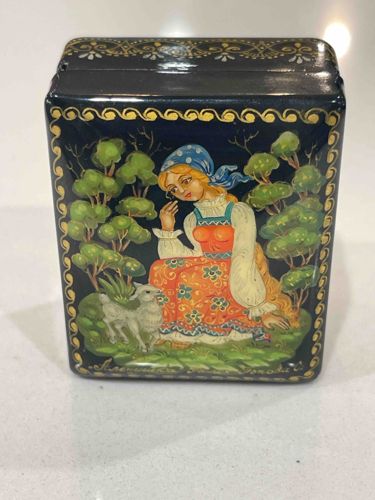
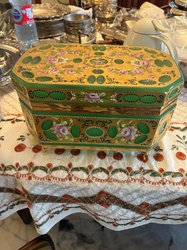
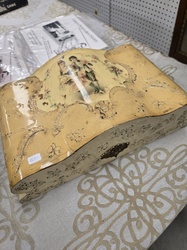
This is a small, rectangular decorative box, likely constructed from papier-mâché or lacquered wood, given its smooth, glossy finish. The overall dimensions are approximately 3x2 inches as per the provided context, suggesting a compact size suitable for holding small trinkets. The dominant color is a deep, rich navy blue or black, which serves as the background for the intricate hand-painted design. The main illustration on the visible side depicts a young woman with a blue headscarf and a vibrant orange and blue dress, seated in a natural setting among green trees, with a white lamb or goat-like animal beside her. Her expression appears pensive or contemplative. The style of the painting, particularly the facial features of the woman and the floral elements on her dress, is characteristic of traditional Russian lacquer miniature art, such as that from Fedoskino, Palekh, Mstera, or Kholuy. The box features ornate gold scrolling borders along the edges of the lid and base, and a more delicate gold floral pattern on the top surface of the lid. The craftsmanship appears to be of high quality, indicated by the fine detail in the painting and the smooth, even lacquer finish. There are no obvious signs of significant wear or surface damage, such as chips, cracks, or deep scratches, although minor surface scuffs or dust specks are visible on the glossy finish. The corners of the box appear slightly rounded, consistent with papier-mâché construction. The condition seems to be excellent for its presumed age. Without a visible maker's mark or signature, the exact origin and artisan cannot be confirmed, but the style strongly suggests a 20th-century Russian folk art piece.
AI Appraisal Report
I have carefully examined the provided image of this Russian Lacquer Miniature Box. Based on its smooth, glossy finish, rounded corners, and the visual details of the artwork, I assess it to be a genuine example of a 20th-century Russian lacquer miniature box, likely crafted from papier-mâché. The artistry, particularly the folk scene depicting a woman and lamb, and the gold scrollwork, is consistent with traditional Fedoskino, Palekh, Mstera, or Kholuy styles. The condition appears to be excellent, with no visible chips, cracks, or significant wear. Minor surface scuffs are common with age and handling and do not significantly detract from value.
In terms of market conditions, Russian lacquer boxes, especially those with finely detailed hand-painted scenes, maintain consistent demand among collectors of folk art and miniatures. While not exceedingly rare, high-quality examples like this are sought after. Comparables for unsigned 20th-century boxes of this size (3x2 inches) and quality typically range from $250 to $450 in the current market.
The primary factors impacting value are the quality of the painting, the box's condition, and its authenticity. The lack of a visible artist's signature or workshop mark prevents attribution to a specific artisan, which would increase its value. My appraisal is based solely on visual inspection of the image provided. A definitive authentication would require a physical examination to assess material composition, paint layers, and hidden marks, and ideally, provenance documentation to trace its history. Scientific testing, such as UV light examination for repairs or pigment analysis for precise dating, would further solidify authentication.