These notes were written by the person who submitted this item. Appraiser.AI has not verified them, and the AI's identification and estimate may rely on them.
AI Estimated Value
Not an official valuation
$25 - $45
AI estimate as of September 20, 2025 · verify with a professional before acting
AI-Generated · Verify before acting
Everything on this page is generated by AI for informational purposes only. AI can make mistakes — the AI may misidentify items or misattribute them (artist, maker, brand, designer, origin, era). This is not an official valuation and should not be used for insurance, sale, tax, estate, legal, or lending purposes — or any decision requiring a certified appraisal. It is not an authoritative claim about any person, brand, or rights holder — do not share or rely on it as a factual statement about a third party. Always consult qualified professionals before making financial decisions.
This analysis also relies on unverified notes provided by the user, which may be incomplete or inaccurate and could affect the result.
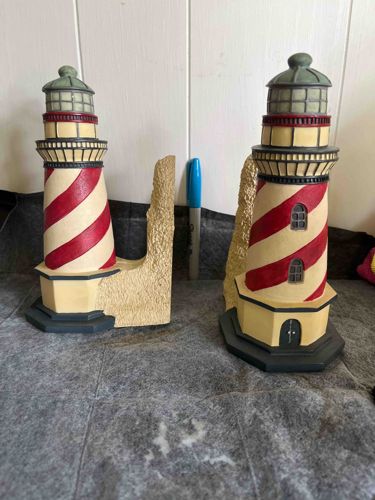
This is a pair of decorative lighthouse bookends, designed to resemble coastal lighthouses. Each bookend features a tall, tapered lighthouse structure predominantly colored with alternating red and off-white (or cream) diagonal stripes, mimicking a candy-cane or barber pole pattern. The base of each lighthouse is hexagonal and painted in the same off-white color, with a dark grey or black hexagonal platform for stability. The top section of each lighthouse includes a dark grey lantern room with grid-like window details and a dark green domed roof. Below the lantern room, there's a gallery or walkway area with black railing details. Small, arched windows are visible on the lighthouse body of the right bookend, and a double-door entrance is depicted on its base. The bookends are constructed to be functional, with a roughly textured, tan-colored support piece extending upwards from the base on the inner side of each lighthouse, designed to hold books upright. The material appears to be a type of ceramic, resin, or painted plaster, offering a substantial feel. The paint finish is matte to semi-gloss. The overall condition appears good with no immediately visible chips, cracks, or significant wear. The design suggests a nautical or coastal decor theme, likely produced in the late 20th or early 21st century. The craftsmanship is typical of mass-produced decorative items, focusing on visual appeal rather than intricate detail or unique artistry. A blue marker is present in the image for scale, suggesting the bookends are of moderate size, perhaps 8-12 inches in height.
AI Appraisal Report
I have examined the provided image of these lighthouse bookends. Visually, the condition appears good, with no obvious chips, cracks, or significant wear, which is positive for their decorative value. The construction suggests a typical mass-produced item made from ceramic, resin, or painted plaster, as indicated by the description. Without a direct physical inspection, I cannot definitively confirm the material or feel the texture described as 'roughly textured.'
These bookends are decorative items, likely from the late 20th or early 21st century, fitting a nautical or coastal decor theme. Items of this nature are generally mass-produced, and as such, their rarity is low. The market for decorative bookends, particularly those with a specific theme like lighthouses, is steady but not highly competitive in terms of high-value items. Comparable items, typically found on online marketplaces or in home decor stores, usually fall within the $20-$60 range depending on size, material perceived quality, and brand.
Factors impacting value positively are their good visual condition and functional design. Negative factors include their mass-produced nature and lack of artistic uniqueness or historical significance. The mention of 'wall hangers' in the owner's details seems to be a misunderstanding or a separate item, as these are clearly bookends designed for a flat surface.
My appraisal value is based on their decorative appeal, good apparent condition, and the general market for similar mass-produced home decor. A physical examination would allow me to confirm the exact material, weight, and detect any subtle defects not visible in the image, which could slightly alter the value. However, given their nature, significant authentication or scientific testing is not typically required or relevant for items in this category. Provenance documentation would only be relevant if these were part of a known collection or had a unique origin story, which is not suggested here.