AI identification & appraisal estimate

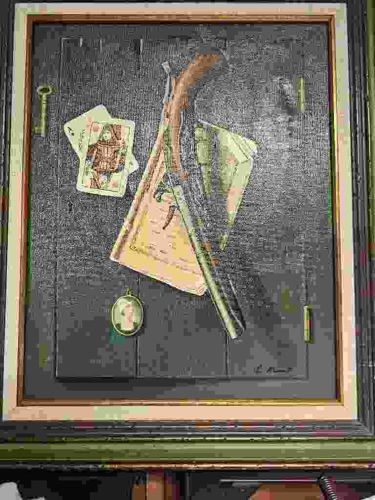
Trompe L'oeil Still Life with Flintlock Pistol and Playing Cards by L. Mint

Submitted photo of Trompe L'oeil Still Life with Flintlock Pistol and Playing Cards by L. Mint
Photo submitted by the user — not generated by AI

User's notes

oil on canvas. artist signed L. Mint bottom right. frame is old

These notes were written by the person who submitted this item. Appraiser.AI has not verified them, and the AI's identification and estimate may rely on them.

AI Estimated Value

Not an official valuation

$400.00 - $700.00

AI estimate as of March 28, 2026 · verify with a professional before acting

AI-Generated · Verify before acting

Everything on this page is generated by AI for informational purposes only. AI can make mistakes — the AI may misidentify items or misattribute them (artist, maker, brand, designer, origin, era). This is not an official valuation and should not be used for insurance, sale, tax, estate, legal, or lending purposes — or any decision requiring a certified appraisal. It is not an authoritative claim about any person, brand, or rights holder — do not share or rely on it as a factual statement about a third party. Always consult qualified professionals before making financial decisions.

This analysis also relies on unverified notes provided by the user, which may be incomplete or inaccurate and could affect the result.

Read the full disclaimer

AI Item Analysis

This is an original oil on canvas painting executed in the 'trompe l'oeil' (fool the eye) style, signed 'L. Mint' in the lower right corner. The composition depicts a collection of vintage-themed objects seemingly pinned or fastened to a dark, vertical wood-plank door. Central to the work is a long flintlock pistol with a curved wooden grip and metallic barrel, angled diagonally across the canvas. Surrounding the firearm are various ephemera, including two playing cards (an Ace of Hearts and a Jack of Spades), a folded parchment letter or map, a skeleton key hanging on the left, and a small oval portrait miniature or cameo at the bottom left. The background simulates rustic, dark-stained wood grain with visible vertical seams and painted hinges on the right. The technique emphasizes depth through the use of sharp shadows cast by the objects against the 'wood,' creating a three-dimensional illusion. The painting is housed in a multi-tiered vintage frame featuring a dark outer moulding, a wide cream-colored linen liner, and a thin gold-toned inner fillet. Visible condition includes some fine surface craquelure consistent with age and a slight aged patina to the frame's linen liner. The style suggests a mid-20th-century interpretation of 19th-century American still life traditions, most notably the 'rack paintings' popularized by artists like William Michael Harnett.


AI Appraisal Report

Based on my examination of this oil on canvas work, I have identified it as a mid-20th-century trompe l'oeil still life signed 'L. Mint.' The composition successfully employs the 'rack painting' tradition, utilizing sharp shadows and realistic textures to create a convincing three-dimensional illusion. The choice of subject matter—a flintlock pistol and playing cards—aligns with the masculine, historicist themes popular in the mid-1900s market. The condition shows fine surface craquelure, which I consider stable and consistent with the age of the materials. The frame, featuring a period-appropriate linen liner, shows some atmospheric patina but remains structurally sound. L. Mint is a recognized hand in the decorative arts market, often associated with high-quality 'commercial' fine art sold through galleries in the 1950s and 60s. While technically proficient, the scarcity of recorded auction records at high-valuation tiers classifies this as a decorative fine art piece rather than a prominent investment-grade work. Comparable works of similar size and subject matter typically realize between $400 and $700 in regional auction houses and antique galleries. Please note that this appraisal is based on photographic evidence. A full authentication would require an in-person physical inspection to verify canvas weave, investigate the pigment depth under UV light (to detect restoration), and examine the stretcher bars for manufacturer stamps or exhibition labels. Access to the original bill of sale or provenance documentation would further solidify the valuation. Without physical testing of the oil binders, I cannot definitively date the work beyond stylistic and visual indicators.

Keep exploring

More fine art - oil painting appraisals

Get your items appraised

Instant AI-powered appraisal estimates from a photo

Browse More Appraisals