AI estimate as of September 5, 2025 · verify with a professional before acting
AI-Generated · Verify before acting
Everything on this page is generated by AI for informational purposes only. AI can make mistakes — the AI may misidentify items or misattribute them (artist, maker, brand, designer, origin, era). This is not an official valuation and should not be used for insurance, sale, tax, estate, legal, or lending purposes — or any decision requiring a certified appraisal. It is not an authoritative claim about any person, brand, or rights holder — do not share or rely on it as a factual statement about a third party. Always consult qualified professionals before making financial decisions.
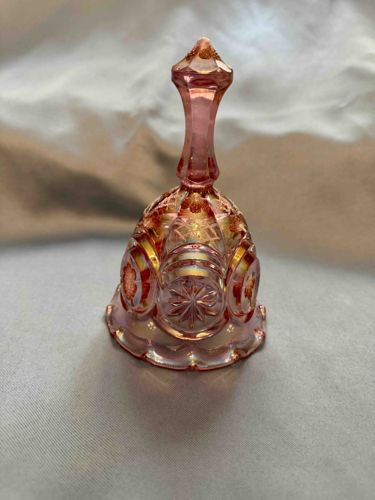
This item is a decorative bell crafted from iridescent pink carnival glass, likely dating from the early 20th century, a period when carnival glass was highly popular. The bell features a complex, molded design across its surface, creating a rich textured appearance. The primary color is a translucent rosy pink, which exhibits a strong iridescent shimmer, particularly in areas where the light catches it, showing nuances of gold, orange, and even subtle green and blue hues. The handle is slender and elongated, tapering to a pointed finial at the top, which appears to have a slightly rough, almost crystalline texture. The bell's body transitions from a wider, domed shape at the top to a flared, scalloped rim at the base. The patterns on the bell proper include raised diamond-shaped sections with crosshatch detailing, intermittent circular medallions, and starburst motifs visible towards the bottom. The craftsmanship suggests press-molded glass, common for carnival glass production, with distinct seams that are characteristic of the manufacturing process. There are no clearly visible chips or cracks, indicating good overall condition for its age. The glass has a smooth, polished finish in most areas, contributing to its lustrous effect. Given its material and style, it is a quintessential example of decorative pressed glass from the Arts and Crafts or early Art Deco periods.
AI Appraisal Report
Upon visual examination of the provided image, this Pink Carnival Glass Bell presents as a quintessential example of early 20th-century decorative pressed glass. Its iridescent pink hue, showcasing gold, orange, green, and blue nuances, along with the distinct molded patterns—diamond-shaped sections, medallions, and starburst motifs—are highly characteristic of carnival glass production. The elongated, tapered handle with its pointed finial and the scalloped rim further align with typical designs from the Arts and Crafts or early Art Deco periods. Based on the image, the condition appears good, with no visible chips or cracks, which enhances its appeal. The distinct seams are also expected for this manufacturing method, contributing to its authenticity.
Market conditions for carnival glass, while stable, have seen fluctuations. Demand is generally consistent among collectors, especially for pieces in excellent condition and less common colors or patterns. Pink carnival glass is desirable, though not as rare as some other specific hues or elaborate patterns. Comparable sales for similar carnival glass bells typically fall within the $50-$150 range, depending heavily on the specific pattern, iridescence quality, and condition. The strong iridescence on this piece is a positive value factor.
Limitations in authenticity verification from an image alone are significant. While it strongly appears to be authentic carnival glass, a physical inspection would be crucial to confirm tactile qualities, actual glass thickness, and precise color variations under different lighting. In-person examination would also allow for a thorough check for hairline cracks, subtle manufacturing flaws that impact value, or repairs not visible in photos. Furthermore, provenance documentation, if available, could definitively confirm its age and origin. Scientific testing, such as spectroscopy, would be an extreme measure and generally not warranted for items in this value range unless specific doubts about materials arose.