AI estimate as of August 11, 2025 · verify with a professional before acting
AI-Generated · Verify before acting
Everything on this page is generated by AI for informational purposes only. AI can make mistakes — the AI may misidentify items or misattribute them (artist, maker, brand, designer, origin, era). This is not an official valuation and should not be used for insurance, sale, tax, estate, legal, or lending purposes — or any decision requiring a certified appraisal. It is not an authoritative claim about any person, brand, or rights holder — do not share or rely on it as a factual statement about a third party. Always consult qualified professionals before making financial decisions.
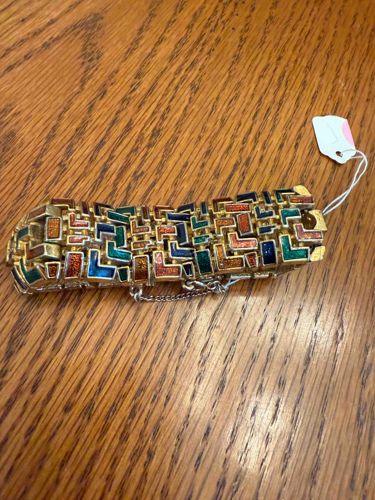
This is a vintage-style bracelet, likely a panel link or brick bracelet, featuring an intricate geometric pattern crafted from what appears to be gold-toned metal with colorful enamel inlay. The bracelet is composed of numerous small, interconnected rectangular and L-shaped segments, creating a tessellated design. The enamel colors predominantly include shades of iridescent blues (navy, sky blue), greens (emerald, teal), and oranges/reds (rust brown, burnt orange), providing a vibrant and varied appearance. The construction indicates a high level of craftsmanship, with each small enamel section appearing well-defined within its metal frame. The metal shows some slight signs of wear consistent with age, possibly light scratching or minor tarnishing, but the overall gold tone is still prominent. Some of the enamel sections show very minor chips or abrasions, visible upon close inspection, suggesting expected wear for an older piece, but no significant damage or missing enamel is apparent. A safety chain runs along one side of the bracelet, attached to the clasp, which is not fully visible but seems to be a box clasp. The design has a mid-20th-century aesthetic, possibly dating from the 1950s to 1970s, which often featured bold geometric patterns and vibrant enamel work. There are no clear maker's marks or signatures visible in the provided image. The bracelet exhibits a solid, weighty appearance, indicative of quality costume jewelry construction, rather than fine jewelry.
AI Appraisal Report
I have examined the provided image of the Vintage Gold-Tone and Enamel Geometric Panel Bracelet. Visually, the piece presents as a well-preserved example of vintage costume jewelry, likely dating from the mid-20th century (1950s-1970s). The intricate tessellated design with vibrant enamel work in blues, greens, and oranges/reds is characteristic of the era. The gold-toned metal exhibits minor wear consistent with age, such as light scratching, but maintains its prominence. The enamel sections show very minor chips or abrasions, which are expected for an older, worn piece and do not significantly detract from its overall appeal. The construction, including the apparent safety chain and what seems to be a box clasp, indicates a solid, weighty build typical of quality costume jewelry rather than fine jewelry.
Market conditions for vintage costume jewelry are relatively stable, with demand often driven by unique aesthetics and good condition. While this piece is attractive, it lacks clear maker's marks, which would significantly increase its value if it were from a renowned designer. The design, while intricate, is not exceptionally rare for the period.
Factors impacting value include its good overall condition despite minor wear, the appealing and vibrant enamel work, and its substantial appearance. The absence of designer attribution and the fact it is costume jewelry rather than fine jewelry limit its upside value.
Limitations apply to authenticity verification from images alone. Without physical inspection, I cannot definitively confirm the metal composition (e.g., gold-filled vs. plated), the exact nature of the enamel (e.g., cloisonné vs. cold enamel), or internal wear on the clasp. In-person examination would allow for precise material testing, a thorough assessment of all wear points, and a search for any very subtle, obscure maker's marks that might not be visible in the provided image. Provenance documentation, if available, would also aid in definitively dating and attributing the piece.