These notes were written by the person who submitted this item. Appraiser.AI has not verified them, and the AI's identification and estimate may rely on them.
AI Estimated Value
Not an official valuation
$40 - $70
AI estimate as of September 18, 2025 · verify with a professional before acting
AI-Generated · Verify before acting
Everything on this page is generated by AI for informational purposes only. AI can make mistakes — the AI may misidentify items or misattribute them (artist, maker, brand, designer, origin, era). This is not an official valuation and should not be used for insurance, sale, tax, estate, legal, or lending purposes — or any decision requiring a certified appraisal. It is not an authoritative claim about any person, brand, or rights holder — do not share or rely on it as a factual statement about a third party. Always consult qualified professionals before making financial decisions.
This analysis also relies on unverified notes provided by the user, which may be incomplete or inaccurate and could affect the result.
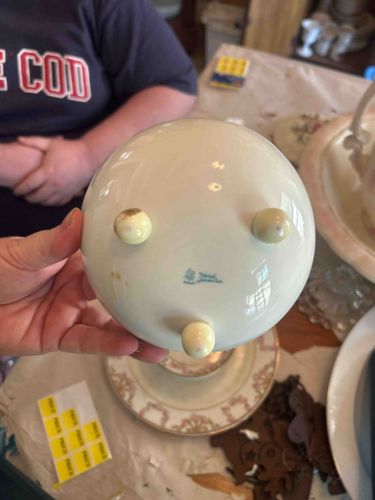
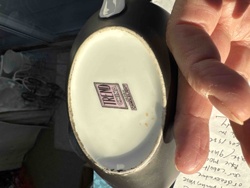
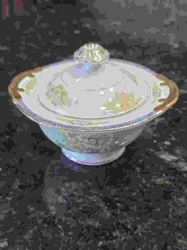
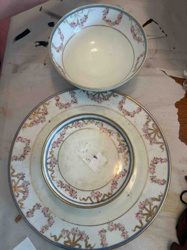
This item is a small, footed bowl, likely made of porcelain or fine china, characteristic of 'Nippon' ware. The bowl has a smooth, rounded, almost spherical body, appearing to be an inverted dome or half-sphere. It is supported by three small, spherical feet, evenly spaced around its base. The primary color of the bowl is a light, creamy off-white or very pale yellow, suggesting an aged patina or a specific glaze. The surface appears glossy. The feet themselves are also creamy white, with one foot showing some brown discoloration or wear on its tip, which could be residue, paint loss, or minor chipping. Another foot shows a fainter, smaller brown mark. The interior or top portion of the bowl is not visible in this image. On the underside, between two of the feet, a blue backstamp is visible. While difficult to read with absolute clarity, it appears to be a 'Nippon' mark, frequently associated with Japanese porcelain produced for export between 1891 and 1921. The mark seems to include stylized text, possibly 'Nippon Hand Painted' or similar, a common hallmark of this era. The craftsmanship suggests a delicate and refined piece, with the hand-painted mark indicating attention to detail. The overall condition appears good, aside from the minor discoloration on the feet. This type of bowl would have been used as a sugar bowl, a trinket dish, or for serving small confections. The elegant design and the known manufacturing period place its estimated age in the late 19th to early 20th century.
AI Appraisal Report
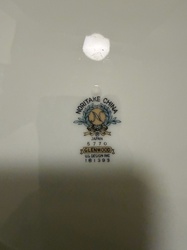
I have examined the provided image of this Nippon footed bowl. Based on the visual evidence, it appears to be a genuine piece of Nippon export porcelain, likely dating from the 1891-1921 period, consistent with the description of its manufacturing era. The form—a small, rounded, three-footed bowl—is typical of sugar bowls or trinket dishes produced during this time. The creamy off-white color and glossy finish are also characteristic. The discernible blue backstamp, though not perfectly clear, strongly suggests a 'Nippon' mark, which aligns with authenticity for this period.
My assessment of the condition, based solely on the image, suggests it is good. The minor brown discoloration or wear on the feet is noted and appears superficial, not significantly impacting structural integrity or overall aesthetics. The lack of visible cracks, chips (beyond the minor foot wear), or significant crazing is a positive factor.
In terms of market conditions, comparable Nippon pieces of this size and form, without elaborate hand-painted decoration (which this piece does not appear to have from the visible angle), generally fetch modest prices. The demand for undecorated or simply glazed Nippon items is moderate. This is not a rare form within the Nippon catalog. Factors that would significantly increase its value would include intricate hand-painted designs, rare molds, exceptional condition, or association with a significant artist or historical context.
It is crucial to state that my authentication and condition assessment are limited by the visual nature of this appraisal. For full authentication and a definitive condition report, I would require a physical examination. This would allow me to inspect for hairline cracks, touch-ups, actual material composition (porcelain vs. fine china), precise identification of the backstamp under magnification, and to accurately assess the nature of the discoloration on the feet. Provenance documentation would also be valuable but is often unavailable for such items.