AI estimate as of September 18, 2025 · verify with a professional before acting
AI-Generated · Verify before acting
Everything on this page is generated by AI for informational purposes only. AI can make mistakes — the AI may misidentify items or misattribute them (artist, maker, brand, designer, origin, era). This is not an official valuation and should not be used for insurance, sale, tax, estate, legal, or lending purposes — or any decision requiring a certified appraisal. It is not an authoritative claim about any person, brand, or rights holder — do not share or rely on it as a factual statement about a third party. Always consult qualified professionals before making financial decisions.
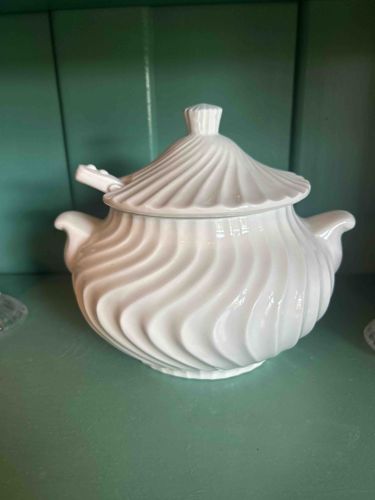
This item is a white ceramic tureen or lidded serving dish, likely used for soups, sauces, or condiments, characterized by a striking swirl or shell-like molded pattern covering its entire exterior surface, including the lid. The material appears to be glazed porcelain or fine ceramic, presenting a smooth, glossy finish that reflects light, suggesting good quality and a well-fired state. The color is a uniform, pristine white, indicating either a modern piece designed for minimalist aesthetics or a traditional piece meant to be versatile in various dining settings. The body of the tureen is rounded with two small, upward-curving handles on opposite sides, integrated seamlessly into the swirl design. The lid fits snugly and features a prominent finial with a fluted or ribbed design, echoing the overall textured pattern of the piece. A notable feature is the cut-out slot on one side of the lid, designed to accommodate a serving utensil, such as a ladle or spoon, which is partially visible peeking out from under the lid. The craftsmanship appears to be of high quality, with no evident chips, cracks, or significant wear visible from the provided images, suggesting it has been well-maintained or is relatively new. The swirl pattern gives it a dynamic, sculptural quality, making it an attractive decorative as well as functional object. There are no visible maker's marks or signatures in the provided views. Based on its clean lines and stylized design, it could date from the mid-20th century to contemporary production, leaning towards a more recent aesthetic due to its seemingly perfect condition and bright white glaze. The base of the tureen appears stable, supporting the weight of the dish and its contents. The item's design suggests it could be part of a larger dinnerware set.
AI Appraisal Report
I have examined the provided image of this white ceramic swirl-patterned tureen or lidded serving dish. The condition appears excellent; I observe no chips, cracks, or significant wear. The smooth, glossy glaze and pristine white color suggest either a very well-maintained older piece or a more modern production. Authentication of its age or maker is impossible from images alone. An in-person inspection would be crucial to look for manufacturer's marks on the base, assess the weight and precise feel of the ceramic, and detect any subtle imperfections not visible in photographs. Provenance documentation, if available, would provide invaluable insights into its history and origin. Without these, definitive claims about its authenticity as an antique or a specific brand cannot be made.
In terms of market conditions, similar well-designed, unmarked ceramic tureens, particularly those with a distinctive aesthetic like this swirl pattern, typically fall into a mid-range price bracket. The functionality for serving and its decorative appeal create moderate demand. While the design is attractive, the absence of known maker's marks or historical significance limits its rarity. Comparables in the retail market for good quality, contemporary, or unmarked vintage ceramic serving pieces suggest a value based primarily on aesthetics, condition, and utility. Factors impacting value positively are its excellent condition and appealing design; negatively, the lack of identified provenance or maker's marks limits its collectible value to enthusiasts of general decor rather than specific ceramic art. Taking these points into consideration, I estimate the value to be within the range of $60 to $120.