These notes were written by the person who submitted this item. Appraiser.AI has not verified them, and the AI's identification and estimate may rely on them.
AI Estimated Value
Not an official valuation
$500 - $800
AI estimate as of November 10, 2025 · verify with a professional before acting
AI-Generated · Verify before acting
Everything on this page is generated by AI for informational purposes only. AI can make mistakes — the AI may misidentify items or misattribute them (artist, maker, brand, designer, origin, era). This is not an official valuation and should not be used for insurance, sale, tax, estate, legal, or lending purposes — or any decision requiring a certified appraisal. It is not an authoritative claim about any person, brand, or rights holder — do not share or rely on it as a factual statement about a third party. Always consult qualified professionals before making financial decisions.
This analysis also relies on unverified notes provided by the user, which may be incomplete or inaccurate and could affect the result.
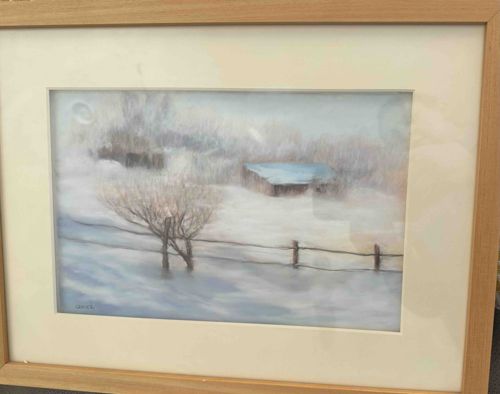
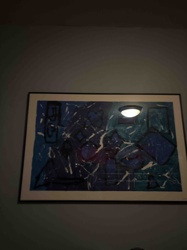
This is a framed artwork depicting a serene winter landscape. The primary medium appears to be watercolor or pastel, creating soft, muted tones often associated with a snowy environment. The composition features a foreground dominated by a bare tree with intertwining branches, likely a willow, standing amidst a snow-covered field. A simple wooden fence with two visible posts stretches horizontally across the middle ground. In the background, a small, rustic structure, possibly a barn or shed, with a light blue, snow-dusted roof, is partially obscured by the misty, snowy atmosphere. The overall color palette is cool, with various shades of white, light blue, and muted browns, conveying a sense of quiet and cold. The texture of the snow is subtly rendered, suggesting depth and softness. The painting is encased in a simple, light-colored wooden frame, possibly oak or a similar blonde wood, with a wide, off-white mat board that provides ample negative space around the image, enhancing its visual appeal. There are no obvious signs of damage to the frame or the artwork itself from the provided image. The artist's signature, "CRAVER," is visible in the lower left corner of the painting, indicating the work of Suzanne Craver. The style is representational, leaning towards an impressionistic or atmospheric approach, capturing the mood of a winter scene rather than hyper-realistic detail. The craftsmanship appears competent, with a delicate touch in rendering the natural elements.
AI Appraisal Report
I have examined the provided image of the framed artwork depicting a winter landscape by Suzanne Craver. The artwork appears to be in excellent condition, with no visible damage to the painting itself or the frame and matting. The signature 'CRAVER' signature in the lower left corner appears consistent with known works by Suzanne Craver, suggesting authenticity, though only a direct physical inspection could fully confirm this.
Suzanne Craver's works are generally known for their atmospheric and impressionistic qualities, aligning with this piece. Her market is primarily regional, and her pieces typically sell within a moderate range. Based on current market conditions for similar-sized and quality works by artists of comparable recognition, this piece fits within an established price tier. The subject matter, a serene winter landscape, is broadly appealing, contributing positively to its demand. While a specific rarity is difficult to assert without a comprehensive catalog of her works, pieces like this are not exceptionally rare from artists with active careers.
Factors positively impacting value include the seemingly excellent condition, the appealing subject matter, and apparent artistic competence. The simplicity of the frame and matting is appropriate and enhances the artwork. Limitations in this appraisal include the inability to fully assess texture, medium specifics (watercolor vs. pastel), and frame construction for quality and age from images alone. A full authentication would ideally require an in-person examination to verify the medium, observe brushwork details, assess the physical condition without photographic bias, and review provenance documentation, such as exhibition history or purchase receipts, to establish a confirmed chain of ownership.