AI estimate as of August 14, 2025 · verify with a professional before acting
AI-Generated · Verify before acting
Everything on this page is generated by AI for informational purposes only. AI can make mistakes — the AI may misidentify items or misattribute them (artist, maker, brand, designer, origin, era). This is not an official valuation and should not be used for insurance, sale, tax, estate, legal, or lending purposes — or any decision requiring a certified appraisal. It is not an authoritative claim about any person, brand, or rights holder — do not share or rely on it as a factual statement about a third party. Always consult qualified professionals before making financial decisions.
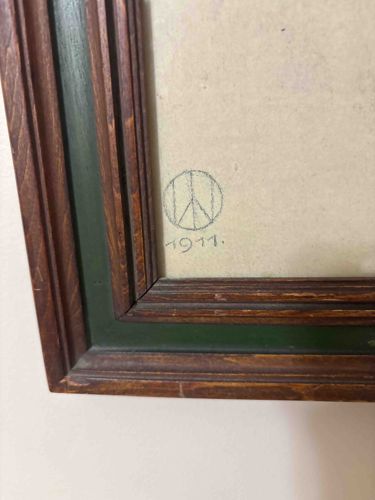
This item is a framed piece of artwork, likely a drawing or print, featuring a distinctive circular mark with an inverted Mercedes-Benz-like symbol, accompanied by the handwritten date "1911." The image captures the lower right corner of the framed piece, revealing details of both the artwork and its frame. The visible portion of the artwork is on a light brown or cream-colored paper, which shows some signs of age such as slight discoloration or foxing. The mark itself appears to be drawn in pencil, indicating a hand-drawn element, possibly a signature, artist's monogram, or a specific mark related to a school or movement. The frame is constructed from wood, exhibiting a rich, dark brown stain with visible wood grain, suggesting a natural hardwood like oak or walnut. It features a traditional, carved or molded profile with multiple parallel ridges, giving it a classic and somewhat ornate appearance. An inner liner or mat section of the frame is painted or stained a deep forest green, providing a contrasting border between the dark wood and the light-colored artwork. The craftsmanship of the frame appears solid, though there are minor signs of wear consistent with its age, such as small nicks or scuffs on the wood, particularly near the corner joint, and a slight darkening or patina on the green inner rim. The overall aesthetic suggests an early 20th-century piece, aligning with the "1911" date. The combination of the specific mark and the precise date makes this an intriguing piece for further research into its origins and potential artist. The condition appears stable with no major visible damage or repairs, just typical age-related wear.
AI Appraisal Report
I have examined the provided image of this framed artwork, noting the distinctive circular mark with an inverted Mercedes-Benz-like symbol and the handwritten "1911" date. The artwork's paper shows age-consistent discoloration or foxing, typical for a piece from this period. The mark, appearing to be in pencil, could be a unique artist's monogram, a school mark, or a personal symbol indicating its origin. This specific mark is key to its identification. The wooden frame, with its dark stain and traditional carved profile, aligns well with early 20th-century aesthetics, and the green inner liner provides a period-appropriate contrast. The frame exhibits minor wear—nicks and scuffs consistent with its age, but nothing suggesting significant damage or requiring extensive restoration. The overall condition is good, reflecting typical age-related patina.
Authenticity: Without in-person examination, definitive authentication is limited. While the date "1911" appears consistent with the item's aesthetic, I cannot confirm the authenticity of the mark or the artwork itself as being from that period or by a specific artist. A physical inspection would allow for examination of paper fibers, aging, and drawing medium. Provenance documentation (e.g., bills of sale, exhibition records, family history) is crucial to establish a concrete ownership history and artistic attribution, which significantly impacts value. Scientific testing, such as pigment analysis or carbon dating of the paper, could further verify its age and authenticity.
Market Conditions and Comparables: Without identifying the artist or the specific meaning of the mark, this artwork is currently valued as a decorative early 20th-century piece. Comparable "unidentified artist" works from this era in similar frames typically sell in the low to mid-hundreds. Demand for such pieces is steady, particularly for those with historical appeal and good presentation. The unique mark and precise date add intrigue and potential for future discovery, which could drastically increase its value if attributed to a significant artist or historical context.
Factors Impacting Value: The primary factor is the current lack of attribution. If the artist behind the mark is identified and noted, especially if they are a recognized figure, the value would rise substantially. Rarity depends entirely on the artist; without knowing the artist, its rarity is currently unknown. The condition is stable, which is a positive factor.
In summary, based solely on visual evidence, and acknowledging the limitations without further research or physical inspection, I value this as an interesting historical decorative item.