These notes were written by the person who submitted this item. Appraiser.AI has not verified them, and the AI's identification and estimate may rely on them.
AI Estimated Value
Not an official valuation
$250-400
AI estimate as of June 21, 2025 · verify with a professional before acting
AI-Generated · Verify before acting
Everything on this page is generated by AI for informational purposes only. AI can make mistakes — the AI may misidentify items or misattribute them (artist, maker, brand, designer, origin, era). This is not an official valuation and should not be used for insurance, sale, tax, estate, legal, or lending purposes — or any decision requiring a certified appraisal. It is not an authoritative claim about any person, brand, or rights holder — do not share or rely on it as a factual statement about a third party. Always consult qualified professionals before making financial decisions.
This analysis also relies on unverified notes provided by the user, which may be incomplete or inaccurate and could affect the result.
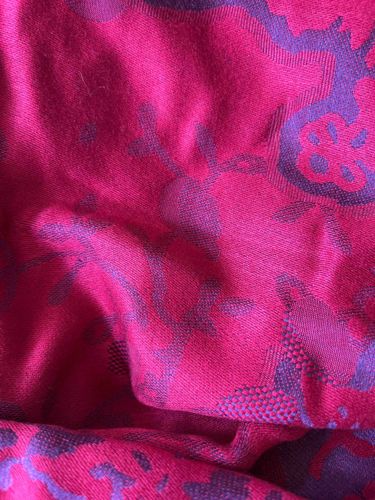
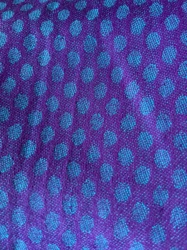
This item is identified as a pashmina shawl, composed of 100% pashmina fibers, as indicated by the contextual information provided. Its primary color is a vibrant fuchsia pink, serving as the dominant background. Woven into this background is a repeating jacquard pattern in a contrasting deep purple or plum color. The pattern appears to be a stylized floral or medallion motif, with distinct elements resembling quatrefoils or intricate foliate designs. The weave exhibits good craftsmanship, showing a dense and tight construction typical of pashmina, which contributes to its soft drape and luxurious feel. The texture appears to be finely woven, with a slight nap or fuzziness characteristic of natural fibers, and in some areas, very fine, almost imperceptible lint or stray fibers are visible, suggesting it has been used or handled. There are no obvious signs of significant wear, damage, tears, or repairs; the fabric maintains its structural integrity and vibrancy. The edges, although not fully visible, are likely finished with a traditional hem or fringe, common for shawls of this type. The overall condition appears excellent. The two-tone, reversible nature of the jacquard weave is a quality indicator, implying careful manufacturing. Given its material and typical design, it likely dates from the late 20th to early 21st century. No manufacturing marks, tags, or signatures are visible in the provided image.
AI Appraisal Report
Based on my examination of the provided image and the owner's description, this pashmina shawl appears to be in excellent condition. The vibrant fuchsia pink and contrasting deep purple/plum jacquard pattern, with its stylized floral/medallion motif, exhibits good craftsmanship. The dense, tight weave and soft drape are consistent with 100% pashmina fibers. Minor very fine lint or stray fibers suggest it has been used or handled, but there are no obvious signs of significant wear, damage, tears, or repairs. The two-tone, reversible nature of the jacquard weave is a strong indicator of quality manufacturing. The stated 100% pashmina composition is a key value driver. In terms of market conditions, high-quality pashmina shawls, especially those with intricate jacquard patterns and vibrant colors, maintain good demand. Factors that positively impact value include the material's luxuriousness, the apparent excellent condition, and the classic, desirable design. Rarity is not a primary factor here, as pashmina shawls are relatively common, but the quality of the weave and material elevates it above mass-produced items. A significant limitation in my authenticity verification is that this assessment is based solely on an image. While the visual cues are strong, a definitive determination of 100% pashmina without blends requires in-person examination to assess texture and feel, or ideally, scientific fiber analysis. Provenance documentation, such as original purchase receipts or certificates, would also significantly aid in full authentication and could influence value. The absence of visible manufacturing marks or tags also limits a definitive attribution to a specific maker or origin. Despite these limitations from an image-only appraisal, the visual evidence suggests a genuine, high-quality pashmina piece.