AI estimate as of November 9, 2025 · verify with a professional before acting
AI-Generated · Verify before acting
Everything on this page is generated by AI for informational purposes only. AI can make mistakes — the AI may misidentify items or misattribute them (artist, maker, brand, designer, origin, era). This is not an official valuation and should not be used for insurance, sale, tax, estate, legal, or lending purposes — or any decision requiring a certified appraisal. It is not an authoritative claim about any person, brand, or rights holder — do not share or rely on it as a factual statement about a third party. Always consult qualified professionals before making financial decisions.
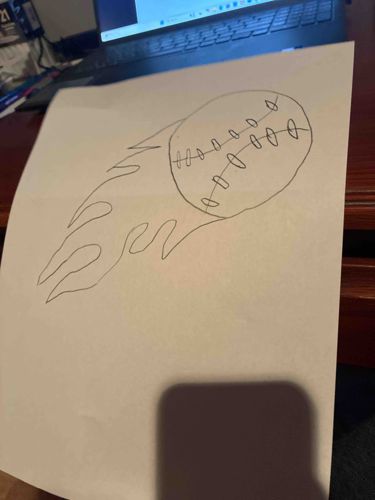
This item is a hand-drawn illustration depicting a baseball with trailing flames. The drawing is executed in black ink or pencil on what appears to be a standard sheet of white printer paper. The baseball itself is rendered as a simple circle with two curved lines representing the seams, along which a series of short, parallel dashes indicate the stitching. The flames emanate from the left side of the baseball, suggesting motion and speed. They are stylized with multiple distinct, undulating tendrils, also outlined in black. The overall aesthetic is minimalistic, focusing on outline rather than shading or intricate detail. The drawing shows no signs of color application. There are no discernible maker's marks, signatures, or stamps evident on the paper. The condition of the drawing appears good, with no visible rips, tears, or significant creases, though a shadow from an overhead object or person is visible in the bottom right corner of the image, obscuring a small portion of the paper. This piece is likely a casual sketch or amateur artwork, possibly created recently given the crispness of the lines and the lack of apparent aging or wear to the paper. The craftsmanship is basic, suggesting it was created by someone with elementary drawing skills. The illustration does not appear to be part of a larger series or a finished professional artwork.
AI Appraisal Report
I have carefully examined the provided image of the "Flame Baseball Drawing." My assessment is based purely on this visual representation, and it's crucial to note that a definitive authentication and valuation would require an in-person physical inspection.
From the image, the drawing appears to be a hand-drawn illustration depicting a baseball with stylized flames, executed in black ink or pencil on standard white printer paper. The condition seems good with no visible rips, tears, or significant creases, although a shadow partially obscures the bottom right corner.
Authenticity is difficult to ascertain from an image alone. There are no discernible artist's marks, signatures, or other identifying features. The simplistic style and basic craftsmanship suggest it is likely an amateur or casual sketch, rather than a piece from a recognized artist. Without any provenance documentation, it's impossible to attribute it to a specific creator or period.
Market conditions for unsigned, amateur, or casual sketches of this nature are extremely limited. There is virtually no established market for such items. Comparables would be difficult to find, as most artwork with salable value possesses artist identification, historical significance, or exceptional artistic merit.
Demand for this type of artwork is negligible, and it cannot be considered rare in a collectible sense. The factors significantly impacting value are the lack of artist identification, the basic execution, and the absence of any historical or cultural significance.
For full authentication, an in-person examination would be necessary to inspect the paper quality, ink type, and drawing technique more closely. This could potentially reveal insights into its age or materials used. Provenance documentation – records of ownership and creation – would be essential to establish any historical context or artistic attribution. Scientific testing of the materials (paper, ink/pencil) could also determine age or composition, but for an item of this perceived value, such testing would be cost-prohibitive and impractical.