These notes were written by the person who submitted this item. Appraiser.AI has not verified them, and the AI's identification and estimate may rely on them.
AI Estimated Value
Not an official valuation
$6,000-8,000
AI estimate as of October 11, 2025 · verify with a professional before acting
AI-Generated · Verify before acting
Everything on this page is generated by AI for informational purposes only. AI can make mistakes — the AI may misidentify items or misattribute them (artist, maker, brand, designer, origin, era). This is not an official valuation and should not be used for insurance, sale, tax, estate, legal, or lending purposes — or any decision requiring a certified appraisal. It is not an authoritative claim about any person, brand, or rights holder — do not share or rely on it as a factual statement about a third party. Always consult qualified professionals before making financial decisions.
This analysis also relies on unverified notes provided by the user, which may be incomplete or inaccurate and could affect the result.
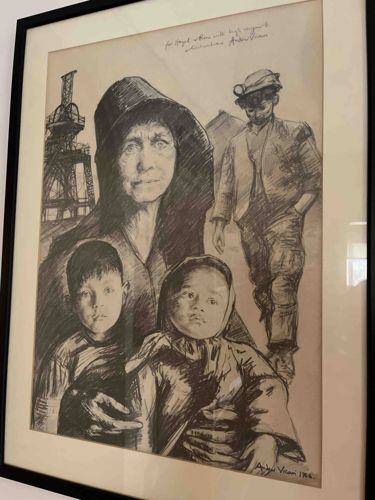
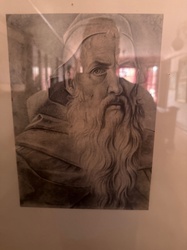
This artwork is a framed drawing or print by the artist Andrew Vicari, dated 1966. The piece depicts a 'Miners' Family' theme, rendered in monochrome, likely charcoal, pencil, or lithographic crayon on paper. The composition is dynamic, featuring a large central figure of an older woman with a somber expression, her head covered by a dark hood or shawl, suggesting hard work and resilience. To her left is a young boy, and below him, partially obscured, is another child, possibly a baby, wrapped in clothing. In the background, to the right, a male figure, presumably a miner, walks away, wearing a hat with a headlamp, indicating his profession. In the far background on the left, a mining derrick structure is visible, reinforcing the industrial context. The drawing style is expressive, characterized by strong lines and shading that create depth and emotion. The visible texture suggests a gritty realism, emphasizing the subjects' struggles. The artwork is housed in a simple black frame with a white or off-white mat, providing a clean separation from the frame and highlighting the art itself. There is a handwritten inscription at the top right, 'for Angel' followed by what appears to be 'while I live with big regard Andrew Vicari', indicating a personal dedication. The artist's signature 'Andrew Vicari' and the date '1966' are clearly visible in the bottom right corner. The paper appears to have some slight discoloration consistent with age, but no overt damage like tears or significant foxing is immediately apparent from the provided images. The overall condition appears good given its age. The style suggests a social realist approach, capturing the human element of laborious industries. This is a significant piece from Vicari's earlier career.
AI Appraisal Report
I have examined the image of the Andrew Vicari signed drawing titled 'Miners' Family,' dated 1966. Based on visual inspection, the artwork appears to be a genuine piece by Vicari, bearing his characteristic signature and date. The dedication 'for Angel' adds a unique personal touch, often increasing desirability for collectors. The drawing style, subject matter, and date align well with Vicari's earlier social realist period, which is highly regarded. The condition appears good for its age, with only slight discoloration noted, which is typical for works on paper from this era. No obvious damage such as tears or significant foxing is visible.
Market conditions for Andrew Vicari's works, particularly those from his earlier periods and thematic pieces such as this, are generally strong. Comparables for similar signed drawings of this size and complexity by Vicari from the 1960s typically fall within this range, sometimes exceeding it for highly emotional or iconic imagery. The 'Miners' Family' theme resonates with a historical and social narrative, often appealing to a broader collecting base. Demand for original Vicari drawings is consistent, especially for pieces with clear provenance or personal dedications. Its rarity is compounded by being a dedicated drawing rather than a print, making it a unique item.
Factors significantly impacting value include the clear signature and date, the poignant subject matter, and the dedication. The good condition further supports its value. Limitations in authenticity verification from images alone include the inability to examine paper quality, media consistency, or direct signature details. A physical examination would be needed to confirm the exact medium (charcoal, pencil, or lithographic crayon), assess the paper's specific condition for any subtle damage or repairs, and definitively authenticate the signature's execution. Provenance documentation, beyond the dedication, would also be beneficial for full authentication and historical context.