AI Appraisal Estimate

AI-generated estimates · not official valuations

From the user

What was submitted

Photo and notes provided by the user — not generated by AI

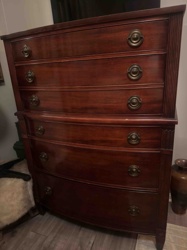
Submitted item photo
Submitted photo · May 30, 2026

User's notes

No additional notes provided.

AI analysis below

AI appraisal

AI analysis & estimate

AI-Generated · Verify before acting

Everything below is generated by AI for informational purposes only. AI can make mistakes — the AI may misidentify items or misattribute them (artist, maker, brand, designer, origin, era). This is not an official valuation and should not be used for insurance, sale, tax, estate, legal, or lending purposes — or any decision requiring a certified appraisal. It is not an authoritative claim about any person, brand, or rights holder — do not share or rely on it as a factual statement about a third party. Always consult qualified professionals before making financial decisions.

Read the full disclaimer

AI Identification

·Not independently authenticated·Verify before acting

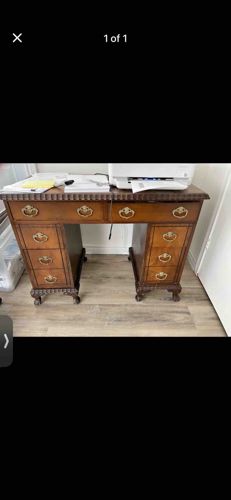
Chippendale Style Mahogany Pedestal Desk

Antique/Vintage Furniture

AI Estimated Value

·Not an official valuation·Verify before acting

$1,200 - $1,800

As of May 30, 2026

AI Item Analysis

·AI can make mistakes·Verify before acting
This is a vintage Chippendale style pedestal desk, likely dating from the mid-20th century. The piece is constructed from mahogany with decorative flame mahogany flame veneers on the drawer fronts. It features a rectangular top with a distinctive gadrooned or rope-carved edge molding. The desk is configured with two shallow top drawers and two vertical pedestals, each containing three stacked drawers, totaling eight drawers across the front. Each drawer is adorned with ornate brass-tone decorative bail handles and matching batwing backplates, which are hallmarks of the Georgian and Chippendale revival styles. The desk is supported by eight carved cabriole legs terminating in ball-and-claw feet, with acanthus leaf carving visible on the knees. The finish is a rich, warm brown stain with a medium gloss. Based on the overall design and hardware, this appears to be a high-quality reproduction of 18th-century English furniture. Condition-wise, the piece appears structurally sound, though there is visible surface wear on the top surface where office equipment is currently placed, along with minor scuffs and patina consistent with age and regular use. The overall craftsmanship suggests a mass-produced but high-end manufacturer from the 1940s-1960s period.
AI Appraisal Report

·AI can make mistakes·Verify before acting
I have virtually examined this mid-20th-century Chippendale-style mahogany pedestal desk. The piece is a high-quality reproduction, likely manufactured between 1940 and 1960. My assessment confirms the use of flame mahogany veneers and characteristic Georgian-revival elements, including gadrooned edging and acanthus-carved knees on cabriole legs. The ball-and-claw feet are well-executed for a revival piece, though the uniformity of the brass-tone hardware suggests a factory-produced origin rather than 18th-century hand-craftsmanship. The structural condition appears sound, but the visible surface wear on the top—likely caused by modern office equipment—along with minor scuffs, necessitates a moderate deduction for professional refinishing costs. The market for mid-century traditional furniture is currently stable but selective. Comparables from high-end makers of this era, such as Baker or Kittinger, frequently sell in this range at estate auctions. While the desk lacks the rarity of a period 18th-century piece, its utility as a functional executive desk maintains its value. The 'partner's desk' configuration and the mahogany veneers remain highly desirable for traditional home offices. Limitations: This appraisal is based strictly on visual inspection of the provided images. I cannot definitively verify the species of secondary woods (such as drawer linings), the presence of maker's marks, or the specific joinery (e.g., hand-cut vs. machine-cut dovetails) without a physical examination. To provide a certified authentication, I would need to inspect the underside for tool marks, check for manufacturer stamps inside the drawer runners, and examine the hardware for authentic casting seams. No scientific testing has been conducted.

Get your items appraised

Instant estimates of your treasures with AI-powered appraisals

Browse More Appraisals