AI estimate as of July 19, 2025 · verify with a professional before acting
AI-Generated · Verify before acting
Everything on this page is generated by AI for informational purposes only. AI can make mistakes — the AI may misidentify items or misattribute them (artist, maker, brand, designer, origin, era). This is not an official valuation and should not be used for insurance, sale, tax, estate, legal, or lending purposes — or any decision requiring a certified appraisal. It is not an authoritative claim about any person, brand, or rights holder — do not share or rely on it as a factual statement about a third party. Always consult qualified professionals before making financial decisions.
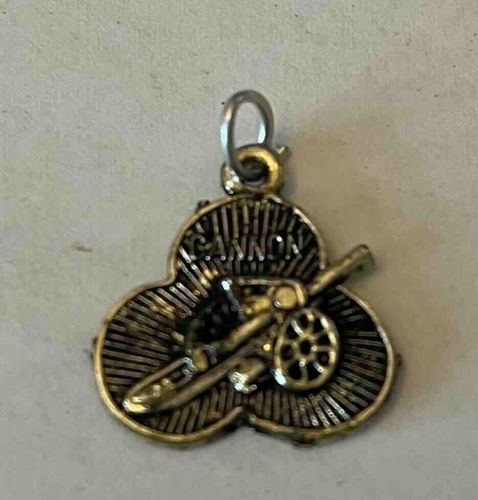
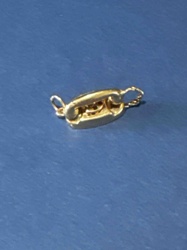
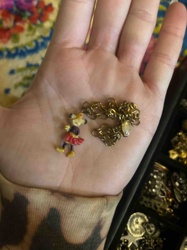
This is a vintage-style metal charm, likely made from a base metal such as brass, bronze, or a lead alloy, given its aged appearance. The charm is relatively small, consistent with typical necklace or bracelet charms. It features a predominantly dark, antiqued finish with lighter, polished highlights that catch the light, enhancing its dimensional quality. The overall shape is a trefoil or clover-like design, composed of three interconnected semicircles or lobes. The central motif depicts a stylized cannon, with clear details of the barrel, carriage, and wheels. Above the cannon, curving along the top lobe, the word "CANNON" is embossed in capital letters. Radiating lines emanate from the central cannon and text, suggesting a sunburst or explosive effect, adding to the charm's visual dynamism. A jump ring is securely attached to the top lobe, indicating it is designed to be worn on a chain or added to a charm collection. The charm shows signs of wear consistent with age and use, including subtle tarnishing and minor surface abrasions, which contribute to its antique patina. There are no immediately visible signs of severe damage, repairs, or specific manufacturing marks, although the aged finish might obscure smaller details. The craftsmanship appears to be of standard quality for mass-produced charms from the mid-20th century onwards, with a clear and legible design. The style suggests it could be from the mid to late 20th century, possibly as a souvenir or themed charm.
AI Appraisal Report
Upon visual examination of the provided image, this Vintage Cannon Trefoil Charm presents as a charming piece of costume jewelry. Its condition appears consistent with a vintage item, displaying a dark, antiqued finish with lighter highlights, subtle tarnishing, and minor surface abrasions, which collectively contribute to an appealing antique patina. I see no immediate signs of severe damage or repairs. The clear embossing of 'CANNON' and the stylized cannon motif suggest a souvenir or themed charm, likely mass-produced.
Authenticity, based solely on the image, points to it being a period-appropriate charm from the mid to late 20th century, likely from a base metal. I detect no red flags suggesting it is a modern reproduction. Market conditions for similar vintage costume charms are generally modest. Comparables on online marketplaces typically range from a few dollars to about fifteen dollars, depending on design, perceived uniqueness, and vendor. Demand for specific, non-precious-metal charms like this is generally niche, driven by collectors of specific themes or vintage costume jewelry. Rarity is not a significant factor here; while unique in its specific design, mass production implies many similar pieces exist.
Factors impacting its value include its good aesthetic condition for its age and its clear, legible design. However, its likely base metal composition and mass-produced nature limit its intrinsic value. No precious metals or gemstones are apparent. To fully authenticate its material composition and confirm its exact manufacturing period, an in-person examination would be crucial. Scientific testing (e.g., XRF analysis) would be needed to definitively determine the metal content, and a thorough review of any potential maker's marks, which are not visible in the image, or provenance documentation would offer further authentication beyond what can be discerned visually.