These notes were written by the person who submitted this item. Appraiser.AI has not verified them, and the AI's identification and estimate may rely on them.
AI Estimated Value
Not an official valuation
$5 - $20
AI estimate as of July 18, 2025 · verify with a professional before acting
AI-Generated · Verify before acting
Everything on this page is generated by AI for informational purposes only. AI can make mistakes — the AI may misidentify items or misattribute them (artist, maker, brand, designer, origin, era). This is not an official valuation and should not be used for insurance, sale, tax, estate, legal, or lending purposes — or any decision requiring a certified appraisal. It is not an authoritative claim about any person, brand, or rights holder — do not share or rely on it as a factual statement about a third party. Always consult qualified professionals before making financial decisions.
This analysis also relies on unverified notes provided by the user, which may be incomplete or inaccurate and could affect the result.
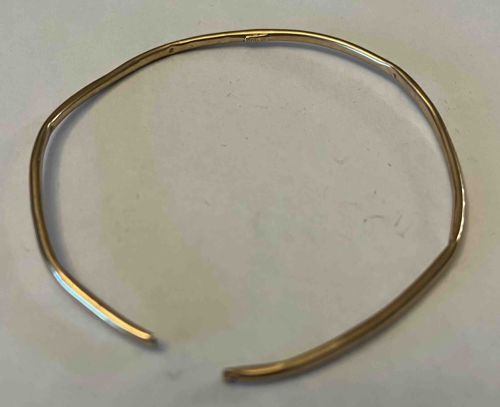
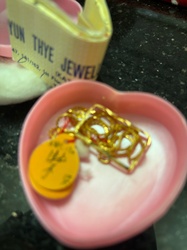
This item is identified as a broken and dented gold-tone wire bangle bracelet. It appears to be constructed from a single continuous wire that has been shaped into a generally circular or oval form, typical of bangle bracelets. The material exhibits a metallic golden color, suggesting it is either gold, gold-plated, or a gold-tone alloy. The wire itself has a relatively thin, constant diameter throughout its visible length.
A significant characteristic is its current damaged state: it is clearly broken into two pieces, with the fracture visible at the bottom center of the image, showing two distinct ends. Additionally, the overall circular shape of the bracelet is compromised by several noticeable dents and bends along its circumference, giving it an irregular, wavy appearance rather than a smooth curve. These deformations are evident in multiple sections, indicating considerable wear or impact damage. There are no visible maker's marks, hallmarks, or distinctive engravings discernible from the provided image, which makes identifying a specific manufacturer or precise material content difficult without further inspection. The simplistic design suggests a minimalist or contemporary aesthetic, though its current condition makes it difficult to ascertain its original intended style or craftsmanship quality. Given the damage, it is in poor physical condition, requiring repair or recycling.
AI Appraisal Report
I have carefully examined the provided image of the gold-tone wire bangle bracelet, noting its general form and current state. Visually, the item appears to be a simplistic bangle crafted from a continuous, thin wire. Its metallic golden color indicates it is either gold, gold-plated, or a gold-tone alloy; however, without hallmarks or scientific testing, I cannot confirm the material's specific composition or karatage—this is a significant limitation of image-based appraisal.
The bracelet is in poor physical condition. It is clearly broken into two distinct pieces, with a visible fracture point. Additionally, the bangle's original circular or oval shape is severely compromised by multiple dents and bends along its circumference, indicating considerable wear, impact, or mishandling. These deformations detract significantly from its aesthetic appeal and structural integrity.
Market conditions for broken or heavily damaged costume jewelry, or even low-purity gold items in such a state, are extremely low. There is virtually no consumer demand for a piece requiring extensive repair or with such significant aesthetic flaws. Its rarity is not a factor here; rather, its common design, coupled with the damage, diminishes any potential value. Without the ability to confirm material content, its value is essentially limited to scrap metal, if it is indeed gold, or negligible if it is base metal/gold-plated. There are no comparables for a damaged item of this type in a retail jewelry market.
To definitively authenticate and determine the material content, an in-person examination would be critical to test the metal (e.g., acid test, XRF analysis), look for micro-hallmarks, and assess the wire's gauge. Provenance documentation could potentially add perceived value if it had historical significance, but none is suggested here. Based solely on visual assessment of its damaged state and unknown material, its value is minimal.