Spanish Revenue Stamp - 25 Céntimos Especial Móvil
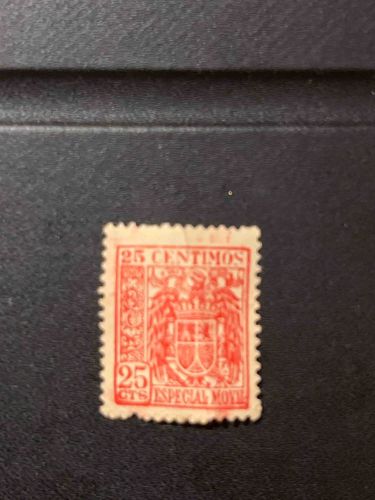
This is a Spanish revenue philatelic item, specifically an 'Especial Móvil' (Special Mobile) revenue stamp with a face value of 25 céntimos. The stamp is printed in a monochromatic vermilion or reddish-orange ink on off-white or aged cream paper. Centrally, the design features the national coat of arms of Spain, complete with a royal crown and heraldic shield, flanked by ornate scrollwork. Text elements include '25 CENTIMOS' at the top, a repeated '25 CTS' in the lower-left corner, and 'ESPECIAL MOVIL' across the bottom margin. The stamp exhibits classic perforation on all four sides, though the perforation appears somewhat irregular or roughly separated, particularly on the bottom edge. In terms of condition, there is visible tanning and toning to the paper consistent with mid-20th-century age, likely dating between the 1930s and 1950s. There are slight ink fades and minor surface soiling, but the central design remains legible. No distinct cancellation marks are visible in this view, suggesting it may be in unused or 'mint' condition regarding postal/fiscal use. The printing method is likely typography or lithography, showing common commercial quality for government-issued fiscal paper of the era.
AI-Generated Appraisal Disclaimer
Estimated Value
$1.50 - $3.00
Basic Information
Category
Philately / Revenue Stamps
Appraised On
January 9, 2026
Estimated Value
$1.50 - $3.00
Item Description
This is a Spanish revenue philatelic item, specifically an 'Especial Móvil' (Special Mobile) revenue stamp with a face value of 25 céntimos. The stamp is printed in a monochromatic vermilion or reddish-orange ink on off-white or aged cream paper. Centrally, the design features the national coat of arms of Spain, complete with a royal crown and heraldic shield, flanked by ornate scrollwork. Text elements include '25 CENTIMOS' at the top, a repeated '25 CTS' in the lower-left corner, and 'ESPECIAL MOVIL' across the bottom margin. The stamp exhibits classic perforation on all four sides, though the perforation appears somewhat irregular or roughly separated, particularly on the bottom edge. In terms of condition, there is visible tanning and toning to the paper consistent with mid-20th-century age, likely dating between the 1930s and 1950s. There are slight ink fades and minor surface soiling, but the central design remains legible. No distinct cancellation marks are visible in this view, suggesting it may be in unused or 'mint' condition regarding postal/fiscal use. The printing method is likely typography or lithography, showing common commercial quality for government-issued fiscal paper of the era.
Related Tags
Get Your Items Appraised
Instant estimates of your treasures with AI-powered instant appraisals