AI estimate as of September 8, 2025 · verify with a professional before acting
AI-Generated · Verify before acting
Everything on this page is generated by AI for informational purposes only. AI can make mistakes — the AI may misidentify items or misattribute them (artist, maker, brand, designer, origin, era). This is not an official valuation and should not be used for insurance, sale, tax, estate, legal, or lending purposes — or any decision requiring a certified appraisal. It is not an authoritative claim about any person, brand, or rights holder — do not share or rely on it as a factual statement about a third party. Always consult qualified professionals before making financial decisions.
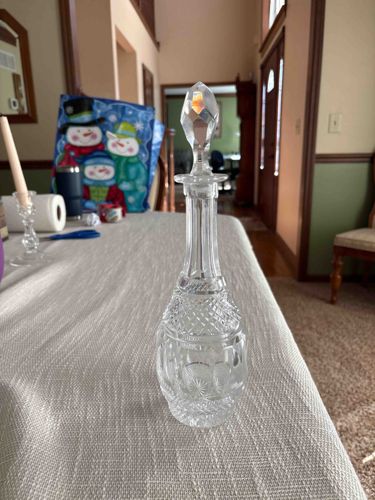
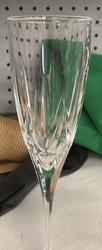
This is a clear crystal decanter, likely made of lead crystal given its brilliance and prismatic qualities, designed for serving spirits or wine. It stands upright on a flat base and features a slender neck leading to a broader, bulbous body. The decanter is highly ornate, showcasing intricate cut-glass patterns. The upper portion of the body is adorned with a cross-hatch or diamond-cut pattern, indicative of fine craftsmanship often found in cut crystal. Below this, there are sections with smooth, oval or circular windows, providing a contrast to the textured areas. The lower part of the body, particularly towards the base, features a starburst or radiating pattern, again demonstrating detailed glass cutting. The decanter is topped with a faceted, pointed crystal stopper, which perfectly fits into the neck, sealing the contents. The stopper itself is multi-faceted, reflecting light and adding to the overall sparkle of the piece. No visible damage such as chips, cracks, or significant scuffs are apparent from the image, suggesting it is in good to excellent condition. The clarity of the glass is high, indicating good quality material and careful cleaning. While the exact age is difficult to pinpoint without maker's marks, the style suggests it could be mid-20th century or later, designed in a traditional elegant manner. The precision of the cuts and the overall finish point to a well-made, possibly mass-produced, but high-quality decorative and functional piece.
AI Appraisal Report
Upon visual examination of the provided image, I assess this clear crystal decanter with stopper to be in excellent condition. There are no visible chips, cracks, or significant scuffs, and the clarity of the glass is exceptional, suggesting good care. The intricate cut-glass patterns, including cross-hatch, smooth oval windows, and a starburst base, indicate fine craftsmanship, likely lead crystal due to its brilliance and prismatic qualities. The faceted stopper fits perfectly, enhancing its aesthetic and functional integrity.
From a market perspective, traditional cut crystal decanters are widely available. While this piece exhibits high quality, the market for such items is generally steady, not experiencing significant surges in demand that would drive prices exceptionally high. Comparables usually fall within the $50-$200 range for well-maintained, unmarked pieces of this type and style. Demand is moderate, appealing to collectors of barware and individuals seeking decorative yet functional items for home entertainment. Rarity is not a significant factor here; while unique in its specific pattern, similar high-quality decanters are common in the secondary market.
Factors significantly impacting value include the excellent condition and ornate cutting. However, the absence of maker's marks, which cannot be determined from the image, limits the verifiable provenance. Without a known manufacturer (e.g., Waterford, Baccarat), it remains a high-quality decorative piece rather than a collectible from a famous maker, which would command a premium. For full authentication and to ascertain any maker's marks, an in-person examination would be essential. Additionally, scientific testing could confirm lead content, though visual cues strongly suggest it. Provenance documentation, such as original sales receipts or historical ownership records, would further enhance its value, but this cannot be ascertained from a photograph alone.